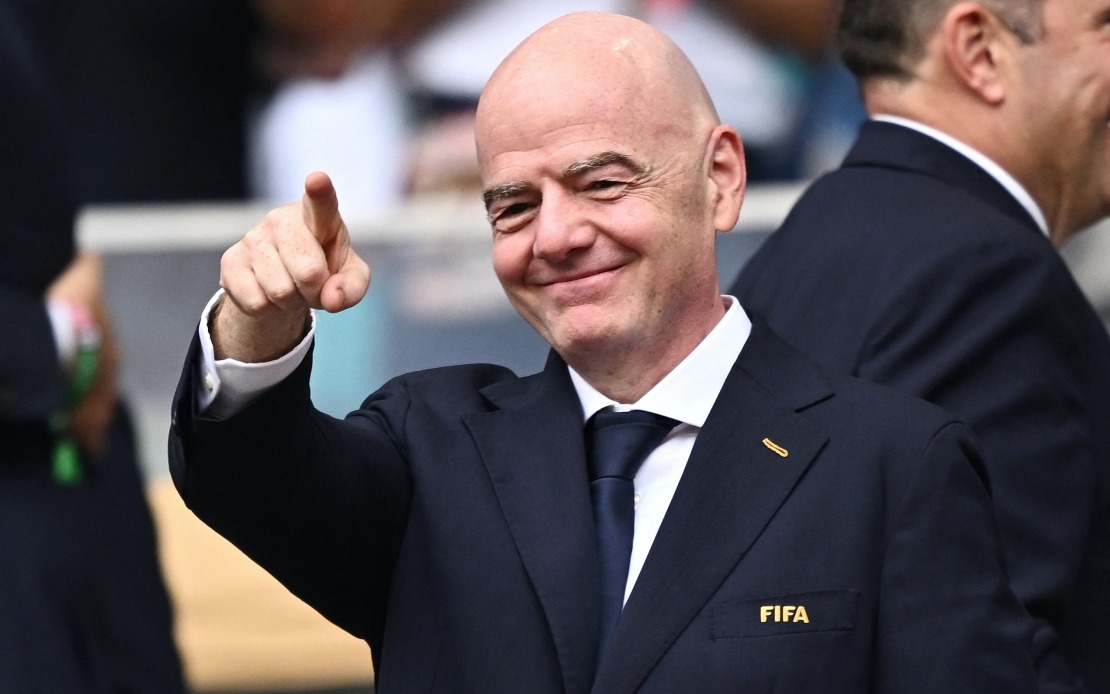
The Football Association of Wales has rescinded its backing for FIFA president Gianni Infantino's bid to secure another term leading world football, marking a significant erosion of support among major confederations for the Swiss administrator. The decision follows Infantino's abortive attempt to sell equity stakes in the FIFA World Cup to private investors through a proposed entity called FIFA Forward Enterprise, a scheme that faced broad rejection and sparked international outcry before being shelved just days earlier.
Infantino's decade at the helm of soccer's global governing body now faces intensifying scrutiny from multiple directions. British Prime Minister Andy Burnham publicly declared on Friday that Infantino represents the "wrong man" to oversee FIFA operations, while England's Football Association has demanded a thorough examination of his stewardship. The FAW's reversal is particularly striking given that the Welsh association had previously signalled its willingness to support Infantino's re-election campaign, but that goodwill has now evaporated entirely in the face of recent events.
In a formal statement released on Monday, the FAW articulated its concerns with remarkable clarity, pointing to deficiencies across multiple dimensions of FIFA's leadership structure. The Welsh governing body cited lapses in governance standards, institutional processes, executive performance, organisational values, and communications with stakeholders as justification for its withdrawal of confidence. Most tellingly, the FAW concluded that Infantino's approach had fundamentally departed from prioritising football's interests, a breach of institutional trust that the association deemed unacceptable.
The English Football Association has similarly moved to distance itself from Infantino, communicating directly to FIFA headquarters that it no longer endorses his continued leadership. England's position became evident through a statement issued on Saturday that explicitly aligned with UEFA's assessment that confidence in Infantino regarding the FIFA Forward Enterprise proposal had been irreparably damaged. UEFA's own response on Saturday notably avoided closing off any potential courses of action, implicitly acknowledging that national associations might consider triggering mechanisms to remove Infantino from office.
The procedural path for such removal, while theoretically straightforward, presents significant practical hurdles. Only 43 of FIFA's 211 member associations would be required to petition for an Extraordinary Congress with the express purpose of holding a vote of no confidence against the FIFA president. However, political calculations suggest that such a dramatic step would likely only proceed if organisers could demonstrate reasonable confidence that a majority of the full membership would vote to unseat Infantino at any such gathering.
CONCACAF, the confederation representing North American, Central American and Caribbean football associations, has also demanded a comprehensive review of Infantino's leadership in the wake of the FFE debacle. Combined with UEFA, these two confederations encompass 96 national associations, representing substantial aggregate voting power within FIFA's overall structure. Notably, CONCACAF's president Victor Montagliani, who currently serves as a FIFA vice-president, has reportedly indicated a willingness to contest Infantino's position in any future presidential election, potentially positioning himself as an alternative candidate.
The emerging divide in the football world reflects deeper questions about FIFA's governance model and institutional culture. Infantino's attempted privatisation scheme represented a fundamental departure from how international football has traditionally structured its operations, and the swift rejection of the initiative demonstrates that even his own constituencies do not necessarily endorse radical departures from established practice. The speed with which major confederations reversed course also underscores how quickly political consensus can shift when institutional leadership is perceived to have strayed beyond acceptable boundaries.
Not all global football bodies have abandoned Infantino, however. Several African and Asian associations have issued statements of support for the FIFA president over the weekend, including national federations from Morocco, Egypt and Qatar. This geographical split suggests that Infantino's support base remains concentrated in regions where FIFA's development funding and other initiatives carry particular strategic importance. The contrast between European and North American criticism and African and Asian backing reflects broader fault lines in global football politics regarding resource distribution and the balance of power within FIFA's governance structure.
For Southeast Asian football stakeholders, the ongoing instability at FIFA's top level carries practical implications. FIFA's funding mechanisms, competition structures, and regulatory decisions directly influence development pathways for national teams and domestic leagues across the region. The uncertainty surrounding Infantino's future creates ambiguity about potential shifts in FIFA's strategic priorities and governance approaches. Should Infantino be removed or forced to stand down, successor leadership might reassess commitments made under his tenure, including development grants and tournament hosting arrangements that several Southeast Asian nations have negotiated or aspired to secure.
The timing of this crisis also intersects with the broader conversation about international sporting governance and transparency. Infantino's attempted privatisation scheme would have introduced private capital into what had previously been exclusively public institutional structures, a fundamentally transformative shift that evidently alarmed confederations and national associations alike. The rejection of this proposal reflects a preference across much of global football to preserve the sport's governance within traditional institutional frameworks, even as FIFA itself faces mounting pressure to demonstrate fiscal responsibility and effective stewardship.
Moving forward, Infantino faces a choice between attempting to restore confidence through demonstrable governance reforms or permitting the political dynamics to proceed toward some form of internal reckoning. The withdrawal of support from major confederations indicates that restoring the status quo ante will prove extraordinarily difficult. Whether his presidency survives the coming months depends partly on whether remaining supporters can mobilise sufficient political capital to protect him and partly on whether critical confederations will eventually translate their expressions of no-confidence into formal procedural action.
The broader significance of the FAW and English FA's moves extends beyond immediate questions about Infantino's tenure. These actions reflect an emerging willingness among established football powers to use formal mechanisms and public pressure to constrain executive overreach at the international level. For Malaysian football officials and administrators observing these developments, the current crisis at FIFA serves as a instructive lesson in the importance of institutional accountability and the limits of executive discretion, even among those holding the most senior positions in global sporting hierarchies.

