George Town rewards visitors who venture beyond the postcard attractions, and Jalan Burma exemplifies why the Penang capital deserves more than a superficial glance. This arterial thoroughfare, stretching nearly five kilometers from the heritage zone toward the affluent Pulau Tikus neighbourhood, encapsulates the city's transformation from a colonial trading post to a modern cultural hub. Yet it remains refreshingly underexplored compared to the crowded lanes of the UNESCO Historic Site, offering travellers an opportunity to experience authentic George Town without fighting through tour groups.
Navigating George Town need not be complicated. The city organizes itself logically around distinct zones and themes that guide both newcomers and repeat visitors. The heritage district—formally designated as the George Town UNESCO Historic Site—clusters around arterial roads including Beach Street, Armenian Street, Carnarvon Street, Chulia Street, and Pengkalan Weld. Here, meticulously restored shophouses, temples, and colonial structures line the lanes, drawing the predictable flow of international tourists. Souvenir emporiums, vintage boutiques, and art galleries proliferate in this sanitized historical bubble. Yet beyond this well-trodden perimeter lies a more textured George Town, where food defines neighbourhoods as powerfully as architecture does.
Penang's culinary reputation rests primarily on nasi kandar, the rice-based lunch dish that has sparked spirited local debate over which establishment serves the definitive version. This obsession, while perhaps parochial, proves pragmatically useful for visitors. The competing loyalties mean that regulars easily direct newcomers toward their preferred spots, effectively creating an edible map of the city. For those preferring systematic guidance, Penang's Michelin presence offers another navigation tool. The selection spans 74 establishments: two awarded one Michelin star, thirty-three appearing on the Bib Gourmand list recognizing exceptional value, and thirty-nine designated as Michelin Selected venues. Many cluster within George Town itself, making a food-focused itinerary both feasible and rewarding.
The appeal of Bib Gourmand entries—particularly those operating from coffeeshops and food courts—transcends mere budget consciousness. Something primal animates the experience of eating in these communal spaces: the layered aromatics of simultaneous cooking, the theatre of preparation visible feet away, the social energy of strangers sharing a meal. When visiting George Town in mid-May, this philosophy guided the choice of Duck Blood Curry Mee on Jalan Burma for breakfast, white curry noodles served with the ritualistic efficiency these humble stalls perfect.
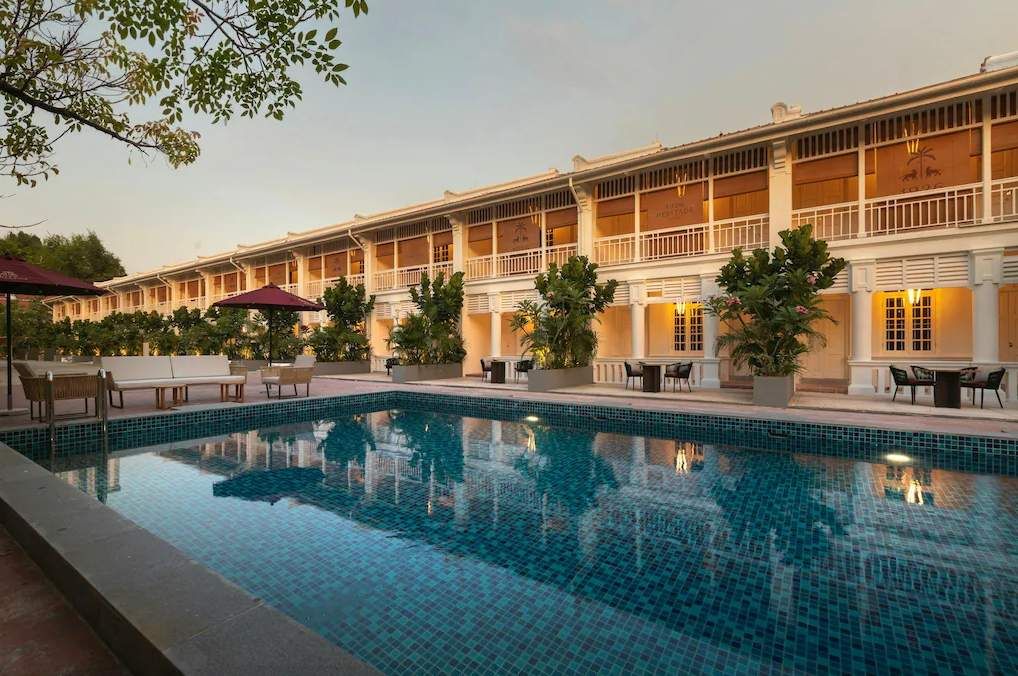
Jalan Burma's heritage credentials centre on a building erected in 1926 that now functions as a boutique hotel, marking a century of continuous existence on this thoroughfare. Originally constructed as residential quarters for British administrators and local officials, the structure embodies the Anglo-Malay architectural vocabulary characteristic of Penang's colonial period. The Penang Development Corporation transformed it into commercial hospitality in 1999, converting twenty-four interconnected townhouses into guest accommodation. Today, seventy-eight rooms and suites occupy these heritage structures, ranging from intimate Heritage Rooms suited to solo travellers to the expansive Straits Suite. The hotel preserves period authenticity while integrating contemporary amenities—including a water filtration system with incongruous WiFi connectivity—that modern guests expect.
Located steps from Duck Blood Curry Mee stands Restoran Old Green House, headquarters of the Bib Gourmand-recognized Green House Prawn Mee and Loh Mee stall. This establishment claims legitimacy as the "original" location, a status reinforced by local consensus despite the existence of a secondary Green House outlet further along Jalan Burma toward Komtar (the optical landmark useful for directionally-challenged visitors). The distinction matters in Penang's fiercely competitive food culture, where provenance and consistency trump mere proliferation. A sequential sampling of both curry and prawn noodles delivered the satisfying satiation that renders further eating temporarily unthinkable, yet somehow inevitable.
The walk from Jalan Burma toward the heritage zone—targeting shops on Lebuh Campbell, Lebuh Kimberley, and Beach Street—stretches approximately four kilometers return, demanding pedestrian fortitude in Penang's tropical heat. The arterial road itself presents a surprisingly pleasant ambulatory experience, with adequate pavement along most sections and notably safe conditions. Few genuinely dangerous pedestrian gaps interrupt the route, making Jalan Burma accessible to visitors seeking exercise without excessive hazard. The borrowed hotel umbrella and small towel proved essential equipment for managing both solar intensity and perspiration accumulation.
Jalan Burma's nomenclature traces an intricate multicultural history inscribed in the landscape. Originally designated "Burmah Road" on colonial-era maps and signboards, the thoroughfare carried multiple indigenous names reflecting Penang's linguistic diversity: three Malay designations, two each in Hokkien and Cantonese. Translation reveals the original practical function—various terms refer to water carts and the bullock animals that transported water through nineteenth-century streets. A Burmese settlement subsequently established itself in Pulau Tikus, prompting the road's renaming in recognition of this community. The legacy persists in surrounding geography: Dhammikarama Burmese Temple, established two centuries ago along a lane branching from Jalan Burma, remains an active spiritual centre; nearby streets bear Burmese names including Rangoon Road, Mandalay Road, and Moulmein Close, preserving toponymic memory of a settlement that shaped this neighbourhood.
George Town's experiential texture deepens when visitors extend their exploration beyond prescribed heritage circuits. Root House by Gen, situated within the boutique hotel on Jalan Burma, presents contemporary Chinese cuisine that satisfies the appetite already diminished by earlier noodle consumption yet somehow accommodates six additional dishes. The adjacent Hin Bus Depot marketplace, activating on weekends, epitomizes the informal cultural economy that flourishes beyond tourist itineraries—local artisans hawking handmade goods, improvised food vendors, caricaturists, and live musicians creating a bazaar atmosphere more authentically Penang than any heritage plaque. This layered approach to discovery—combining Michelin guidance with street food exploration, heritage hotel stays with weekend market wandering—transforms a brief Penang visit from a checkbox exercise into genuine cultural engagement. The city rewards explorers willing to navigate its complexity rather than consume its curated highlights sequentially.

