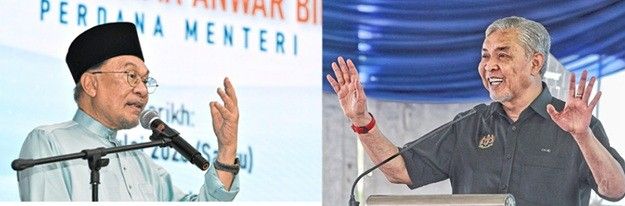
The exchange of pantun between Malaysia's top political leaders this week offers a rare glimpse into how coalition tensions are being managed beneath the surface of the unity government. When PKR president Anwar Ibrahim posted a carefully crafted four-line verse on social media during the heated Negri Sembilan campaign, he was delivering far more than cultural nostalgia—he was sending a calculated political signal. The poem's message was deceptively simple: despite fierce electoral competition at the state level, the national partnership between Pakatan Harapan and Barisan Nasional must remain unbroken. Umno president Zahid Hamidi's immediate pantun response the following day, however, suggested that complacency would be misplaced. His verse about a roof that could be blown away by storms hinted at fragility in an arrangement that, while functional, remains perpetually vulnerable to external shocks.
In the intricate language of Malaysian political culture, the pantun serves purposes that transcend mere versification. This traditional Malay poetic form has become a sophisticated tool for strategic indirectness, allowing political leaders to deliver pointed criticisms, signal truces, or test the boundaries of acceptable discourse without explicitly breaking the unwritten rules of political decorum. The four-line structure provides plausible deniability while remaining instantly comprehensible to supporters. A well-timed pantun can defuse tension on the campaign trail, transform complex factional disputes into memorable cultural references, and communicate intricate coalition mathematics through imagery drawn from nature, daily life, or shared historical memory. This cultural sophistication allows Malaysian politics to function at multiple levels simultaneously: the public face of cooperation masks the private reality of intense competition and mutual suspicion.
Among current practitioners, one figure stands out as the undisputed master of this art form. Datuk Seri Dr Ahmad Maslan, Umno's Pontian MP and Deputy Minister of Works, has earned near-legendary status as the Raja Pantun through years of weaponising verse on campaign stages. His deployment of pantun during the March 2022 Johor state elections exemplified this mastery, particularly in how he recycled a viral verse from the 2019 Tanjung Piai by-election while maintaining tactical flexibility. The original verse explicitly named Pakatan Harapan as the target of his criticism, but when the political landscape shifted and Umno found itself in coalition with former opponents, Ahmad demonstrated remarkable adaptability. He simply replaced the specific party name with the deliberately vague phrase "parti itu"—that party—a move that preserved his signature wit and messaging while allowing him to operate within the new coalition framework. This flexibility revealed something fundamental about how Malaysia's political establishment actually operates: rhetoric and alliances must remain fluid enough to accommodate shifting power arrangements.
The Negri Sembilan state campaign has exposed a peculiar coalition geometry that illustrates the fragility of Malaysia's current political arrangement. Within the unity government framework, the usual hierarchies of competition have been scrambled. Bersatu, the Perikatan component party, occupies an almost paradoxical position: nominally part of the coalition yet competing aggressively in 24 seats where it faces off against both Barisan and Perikatan, as well as Pakatan Harapan. This dynamic creates what observers have characterised as Bersatu playing spoiler to its own supposed allies, a dynamic that could inadvertently benefit Pakatan by fragmenting the opposition vote. Yet this tactical miscalculation, if sustained, might force Bersatu leadership to undertake a fundamental strategic re-evaluation. The party faces an uncomfortable choice: continue its oppositional stance within the coalition or acknowledge political reality and seek accommodation with Pakatan.
Packatan's own internal dynamics in Negri Sembilan reveal different but equally significant pressures. The 2023 state election results showed Pakatan's strength concentrated heavily in one component: DAP secured 11 of the coalition's 17 seats, while PKR won five and Amanah took just one. This dominance gives DAP outsized influence over coalition strategy, but it comes with considerable strategic risk. As DAP's rhetoric against Umno and PAS becomes sharper and more confrontational, it risks triggering a backlash among Malay-Muslim voters who might otherwise be persuadeable. The calculus is delicate: aggressive opposition rhetoric energises the DAP base and appeals to urban, non-Muslim voters, yet it simultaneously pushes fence-sitting Malay voters toward consolidation behind the Barisan-Perikatan bloc. This tension between electoral strategy and coalition cohesion represents one of the deepest challenges facing Pakatan moving forward.
The poetry of these power plays reveals the constraints under which Malaysian political leaders currently operate. The unity government exists not because of ideological convergence or historical reconciliation, but because of electoral mathematics and the desire among competing elites to avoid the chaos of genuine political alternation. The pantun exchanges between Anwar and Zahid should be read as negotiations conducted in a coded language that both sides understand intimately. The verses allow leaders to signal both commitment to the broader arrangement and preparation for its potential collapse. They communicate the boundaries of acceptable behaviour while maintaining the fiction of harmonious cooperation. This is not unusual in Malaysian politics, where surface unity and subsurface competition have long coexisted, but the unity government arrangement places these tensions under unusual strain.
The implications for Malaysian and Southeast Asian observers lie in recognising that the current coalition framework remains fundamentally unstable, held together by mutual interest rather than genuine alignment. The Negri Sembilan campaign offers a microcosm of larger national pressures. If Bersatu's vote-splitting strategy significantly damages the Barisan-Perikatan partnership's electoral performance, recriminations could cascade upward to federal level. Alternatively, if Pakatan emerges with an unexpectedly strong result, it may calculate that the costs of coalition with Barisan have become excessive. The pantun exchanges are not mere cultural ornamentation; they are genuine attempts to manage expectations and signal resolve during a period of acute political uncertainty.
For Malaysian voters attempting to navigate this complex landscape, the poetic language masks substantive disagreements about governance philosophy, economic direction, and the relationship between federal and state authority. The unity government represents an unprecedented experiment in Malaysian politics, one where parties that have viciously opposed one another now share cabinet seats and national decision-making authority. That such an arrangement can function at all testifies to the discipline of the political class and the strength of institutional constraints. Yet the Negri Sembilan campaign demonstrates that this discipline cannot be taken for granted. The pantun verses being exchanged are not merely elegant cultural expressions but rather essential mechanisms for managing a political situation that could rapidly destabilise if communication channels broke down or if party leaders abandoned the language of indirectness for the language of explicit confrontation.

