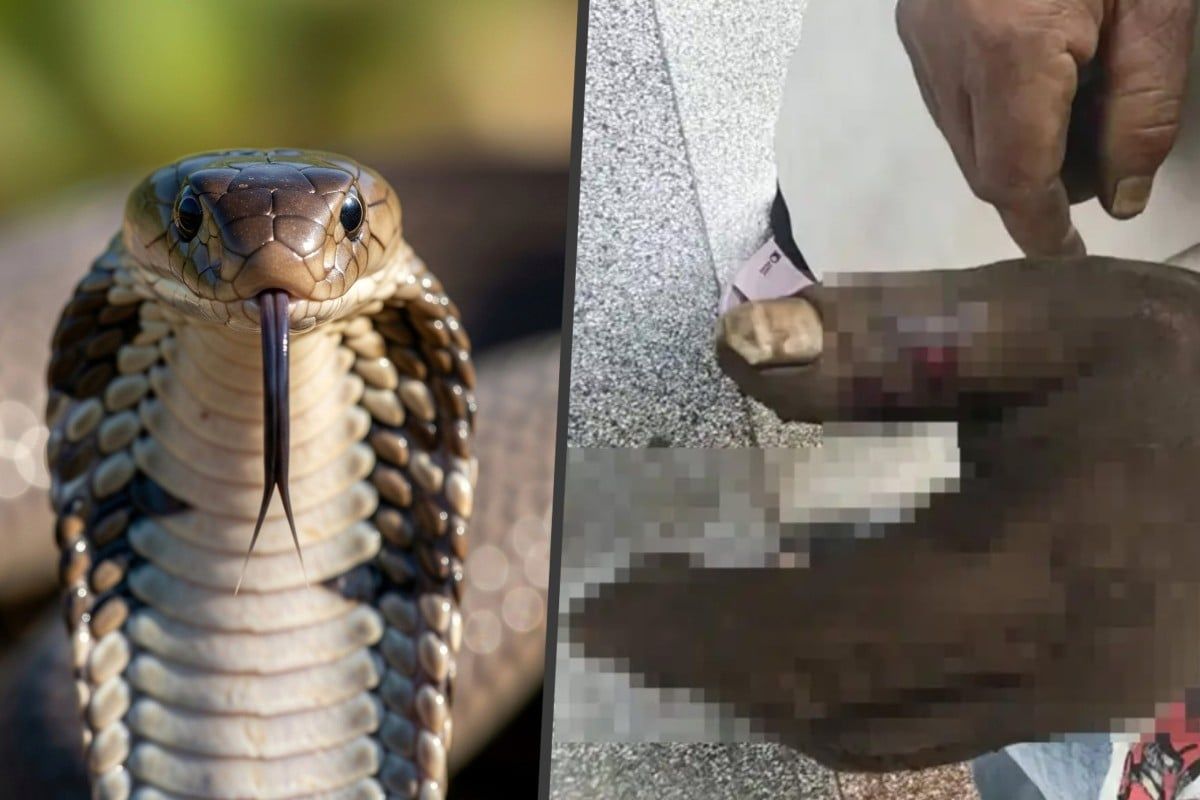
A farmer in Yunnan province's Yuanyang county discovered the hard way that television dramatisations of snakebite treatment can prove disastrously inaccurate when a cobra struck his finger whilst he worked his field. What followed was an unintended medical emergency involving both spouses, illustrating how well-meaning but misguided first aid interventions can transform a serious injury into a compound crisis. The incident, reported by Jimu News, has reignited discussion across Chinese social media about the dangers of mimicking emergency procedures portrayed in entertainment media without professional guidance.
The initial bite itself caused predictable symptoms—swelling at the wound site and progressive weakness accompanied by dizziness. The farmer's wife, confronted with an apparently critical situation and drawing on memory of scenes she had watched on screen, made the decision to extract the venom manually by applying her mouth directly to the puncture wound. She had no protective equipment, no medical training, and no understanding of the physiological consequences her action would trigger. Her husband was transported to hospital, but her intervention set in motion a sequence of events that would soon place her in an equally vulnerable position requiring hospitalisation.
Within hours of the initial rescue attempt, the wife began experiencing neurological symptoms indicating she had absorbed a significant dose of the toxin. Numbness spread through her mouth, tongue, face and limbs. By the following day, the fatigue had intensified sufficiently that her family recognised something had gone dangerously wrong and rushed her to Honghe Prefecture No. 3 People's Hospital. Medical staff at the facility identified that both patients had suffered envenomation from a local cobra species and administered antivenom serum along with supportive medical treatment. Fortunately, within days both the farmer and his wife stabilised and were discharged, but the outcome could easily have been catastrophic had treatment been delayed further.
Physicians at the Yunnan hospital seized the opportunity to educate the public about why venom extraction by mouth represents a fundamentally flawed rescue technique. The oral mucosa contains an exceptionally rich network of tiny blood vessels that create an ideal pathway for toxins to enter the bloodstream with remarkable speed. Any contact between venom and these delicate tissues immediately begins a process of absorption that no amount of suction can reverse. The wife's oral cavity thus became a direct route for the cobra's neurotoxins to circulate through her body, with consequences nearly as severe as those affecting her husband.
Beyond the oral transmission route, snakebites themselves present anatomical challenges that render extraction essentially impossible. The fangs of a striking cobra penetrate only millimetres into skin, creating wounds resembling tiny pinholes rather than the gaping openings depicted in films. Once deposited, the venom disperses rapidly into subcutaneous tissues and enters the bloodstream through diffusion rather than pooling at the surface where suction might theoretically remove it. By the time a rescue attempt begins, the toxin has already begun its journey into deeper structures, making manual removal an exercise in futility at best and a source of additional harm at worst.
The medical establishment in Yunnan has identified several other dangerous misunderstandings that commonly arise from entertainment media portrayals. Cutting around the wound to encourage bleeding represents a particularly hazardous intervention, as it risks causing the already-injured individual to haemorrhage excessively or develop serious infection at the laceration site. Application of heat—using fire or heated implements—or conversely applying ice to attempt to slow toxin circulation, both represent counterproductive actions that can cause additional tissue damage without providing therapeutic benefit. The accumulated effect of these misguided interventions can rapidly transform a manageable medical emergency into something far more life-threatening.
Instead, the correct response to a suspected snakebite involves immediate contact with emergency services to mobilise professional medical response. Immobilising the bitten limb to minimise circulation of venom through the lymphatic system constitutes genuine first aid. Gathering information about the snake's appearance—its colouration, scale patterns, head shape and any other identifying characteristics—provides critical data that allows emergency physicians to administer the appropriate antivenom formulation. If feasible, documenting the snake's appearance through photography ensures that medical teams can make definitive identifications rather than guessing which antivenin to deploy.
The Yunnan case reflects a broader pattern of snakebite incidents capturing public attention across China, often with dramatic outcomes that underscore the seriousness of envenomation. In May, a fourteen-year-old student in Guangdong province experienced a bite whilst in school grassland but initially dismissed the injury as trivial because he experienced no immediate pain and did not clearly identify what had attacked him. Hours later, when numbness spread through his limbs and his vision blurred, the true severity became apparent. Medical personnel informed his family that delaying treatment by merely one or two additional hours would have resulted in respiratory failure and death. The rapid onset of life-threatening neurological symptoms illustrated how cobra venom can transition from apparently inconsequential to fatal within a compressed timeframe.
The incident in Yunnan generated substantial discussion on Chinese internet platforms, where observers noted that the wife's actions, whilst ultimately harmful, reflected genuine affection and a desire to help her husband in his moment of apparent crisis. One commenter reflected that the case demonstrated how television dramas frequently portray medical procedures that lack any grounding in scientific reality, potentially misleading viewers into adopting dangerous practices. The episode serves as a cautionary reminder to Malaysian and Southeast Asian populations that entertainment media should never be trusted as a source of medical guidance, particularly in scenarios involving poisoning or envenomation where professional intervention remains non-negotiable and folk remedies invariably cause harm.

