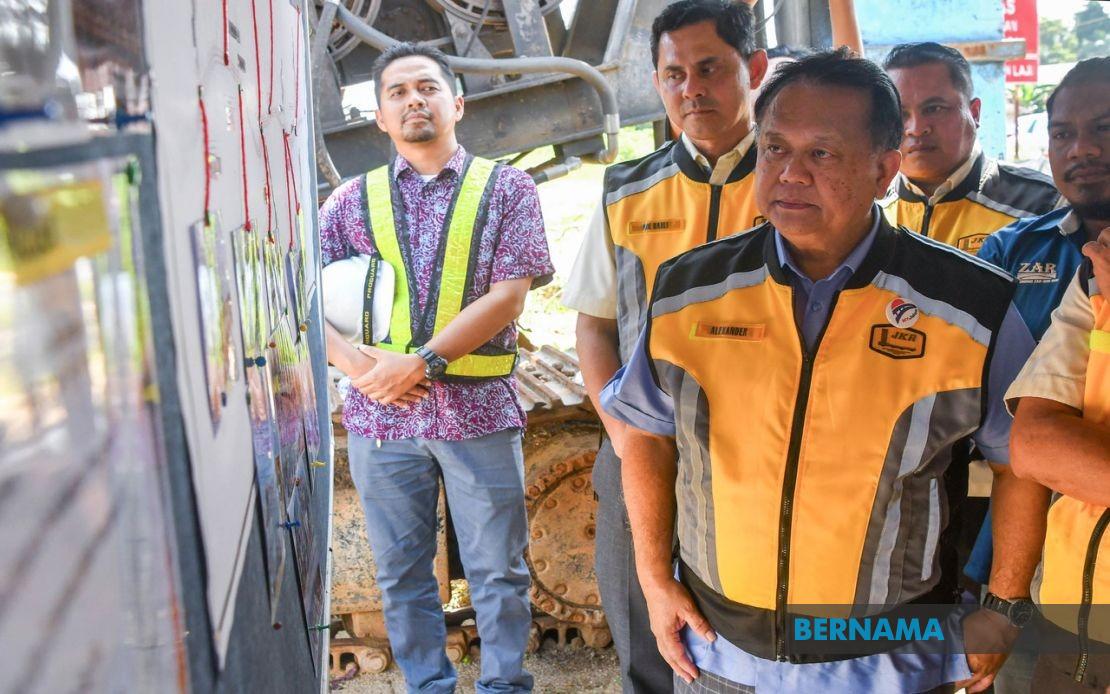
Malaysia's Works Ministry is stepping up its monitoring of 50 underperforming projects across the country as part of a comprehensive effort to bring delayed infrastructure schemes back on track. Works Minister Datuk Seri Alexander Nanta Linggi disclosed the initiative while visiting a major road upgrading project in Kota Bharu, revealing that these problematic developments have been identified from a much larger portfolio of 865 projects currently managed by the ministry. The disclosure underscores growing attention to project delivery performance within government infrastructure departments, where delays can cascade into broader economic impacts and public frustration.
The ministry's identification of 50 "sick" projects represents a selective focus within its vast administrative remit, though the scale of government infrastructure remains substantial. In Kelantan specifically, only seven of the ministry's 104 active projects have been flagged for concern, suggesting that while delays are evident, they remain concentrated within a minority of schemes. This geographic variation hints at broader systemic issues that may differ across regions—some areas may face more acute contractor capacity problems, while others grapple with distinct land acquisition or environmental challenges. The minister's acknowledgment of these diverse problem sources demonstrates a more nuanced understanding of project failure than simple contractor incompetence, recognizing instead the complex interplay of financial distress, bureaucratic obstacles, and unforeseen technical complications.
According to Nanta, the factors undermining project progress are multifaceted and require tailored intervention strategies. Contractors facing internal financial difficulties or poor management practices represent one category of difficulty, while external factors such as land acquisition delays and utility relocation issues constitute another. Particularly telling is the ministry's recognition that underground obstructions discovered during construction—problems invisible during the planning phase—can derail timelines and budgets. This acknowledgment reflects lessons from infrastructure projects across the region, where geological surveys and soil investigations have become essential to realistic scheduling. For Malaysian readers invested in infrastructure development, this transparency about planning limitations offers both reassurance that the ministry understands real-world complications and concern that such complications weren't better anticipated.
The ministry's response strategy demonstrates a pragmatic approach balancing cost efficiency with accountability. Rather than reflexively terminating contracts and appointing replacement contractors for all delayed projects, the ministry assesses the remaining work proportion and the relative cost of continuation versus termination. When projects are approaching completion with only 10 to 15 percent of work outstanding, granting time extensions becomes economically sensible compared to contract termination, which would trigger administrative costs, legal exposure, and the expense of securing and mobilizing new contractors. This calculus, while fiscally reasonable, raises questions about whether contractors might exploit this flexibility by deliberately stretching out final phases. The minister's emphasis on case-by-case assessment suggests confidence in the ministry's ability to distinguish between genuinely constrained projects and those experiencing artificial delays.
Weekly monitoring protocols represent the operational backbone of this oversight regime, with reviews occurring in the aftermath of Cabinet meetings to permit rapid escalation of critical issues. This cadence—far more frequent than the quarterly or annual reviews common in some government contexts—signals serious commitment to active management. The minister has delegated deputy oversight responsibility for coordinating nationwide monitoring, distributing the administrative burden across senior leadership. This structural arrangement potentially improves information flow and decision-making speed by ensuring that project-level data reaches decision-makers through established channels rather than ad hoc reporting. For Malaysian infrastructure stakeholders accustomed to opacity in project status, this weekly review cycle represents a meaningful shift toward transparency and responsive governance.
Contractor removal and contract termination remain available tools when projects persistently underperform, yet the ministry emphasizes careful procedural adherence to mitigate legal complications. Governments across Southeast Asia have encountered costly litigation arising from contract terminations perceived as arbitrary or procedurally defective, making the minister's caution understandable. The qualification that "any decision to terminate a contract must be made carefully and in accordance with proper governance" reflects institutional learning from previous disputes. This methodical approach may frustrate those demanding swift action against underperforming contractors, yet it protects public funds by avoiding litigation costs and enables contractors to mount legitimate legal defenses.
The Kelantan road project exemplifies both the scale of government infrastructure investment and the multifaceted challenges complicating delivery. The FT209 and FT131 road upgrading project represents a RM191 million commitment to address chronic traffic congestion affecting approximately six kilometers of Federal Road FT131, specifically the route connecting Kubang Kerian, Sabak, and Pengkalan Chepa. This regional context matters considerably—traffic congestion in Kelantan's principal urban corridors affects commercial logistics, commuter productivity, and emergency service response times. The project's strategic importance extends beyond the immediate Kota Bharu metropolitan area, potentially influencing regional trade patterns between northern Peninsular Malaysia and Terengganu.
Progress on the road project stands at 71.61 percent physical completion, placing it on track for the September next year deadline, though substantial cost overruns have materialized. Land acquisition alone—encompassing 300 individual land lots—has consumed more than RM200 million, suggesting significant underestimation in the project's land compensation budget or unexpectedly complex ownership patterns requiring negotiated settlements. For Malaysian property owners in infrastructure development corridors, such costs underscore the substantial financial burden that large projects place on government budgets, particularly when compensation practices emphasize fair market value rather than minimal displacement costs. The land acquisition complexity hints at the bureaucratic obstacles the minister identified as contributing to project delays.
An unexpected but increasingly common challenge has emerged during construction: flooding affecting nearby residents as a consequence of project works. The Pengkalan Chepa Member of Parliament, Datuk Dr Ahmad Marzuk Shaary, brought this concern to the minister's attention during the site visit, prompting immediate directive action. The ministry's response—instructing the contractor to construct a temporary 40-metre drainage channel to mitigate flooding until project completion—demonstrates responsive governance while also suggesting that drainage implications weren't fully anticipated during design phases. This interim solution addresses immediate community grievances while the permanent infrastructure remedies incorporate improved drainage design. The willingness to intervene in localized environmental problems reflects political sensitivity to constituency concerns, particularly relevant in a state where infrastructure projects can influence electoral sentiment.
For Malaysian and Southeast Asian observers, this case study illuminates both promising practices and persistent vulnerabilities in large infrastructure delivery. The ministry's systematic identification and weekly monitoring of underperforming projects, combined with differentiated responses calibrated to project-specific circumstances, represents institutional maturation. The emphasis on careful contractual procedures and cost-benefit analysis in termination decisions suggests evolution beyond reactive, sometimes arbitrary project management. Yet the discovery of unforeseen site conditions, land acquisition complexity, and drainage problems during construction indicates that planning and design phases remain improvable, as does the communication between project design teams and affected communities. The RM191 million Kelantan project, while progressing reasonably well at 71.61 percent completion, exemplifies how even moderately scaled infrastructure schemes encounter multiple complications requiring active ministerial engagement. As Malaysia pursues ambitious infrastructure development through programs like the Twelfth Malaysia Plan, maintaining this level of focused monitoring while improving upfront planning accuracy will remain critical to delivering projects efficiently and protecting public investment.

