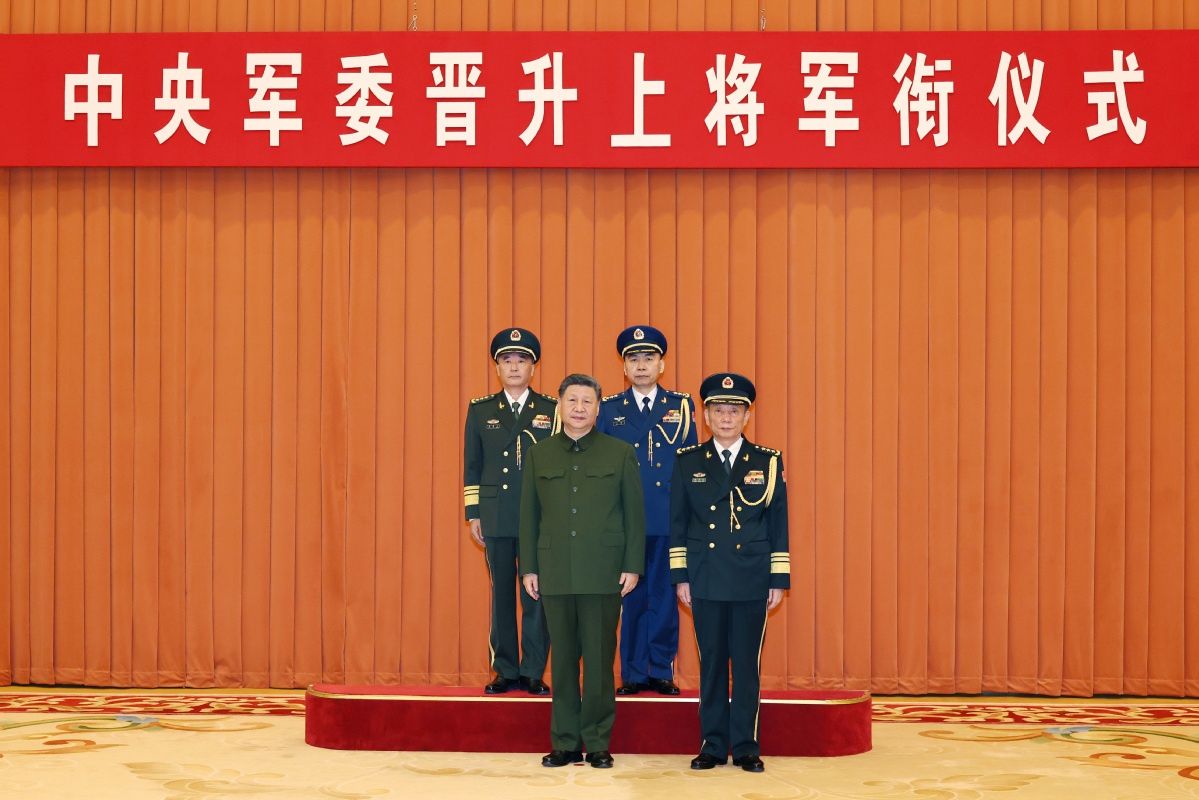
China's military establishment has undergone another significant leadership transition, with President Xi Jinping appointing Zhang Shuguang to oversee anti-corruption efforts within the People's Liberation Army. The announcement, confirmed by state media Xinhua at a ceremony in Beijing on Friday, marks a fresh phase in an extraordinarily broad campaign to reshape the country's defence apparatus. This reshuffle comes as part of what analysts describe as the most sweeping military reorganisation since the Cultural Revolution, reflecting Xi's determination to strengthen his grip over an institution critical to his political survival and China's strategic interests.
Zhang Shuguang now assumes the role of secretary of the Central Military Commission's discipline inspection commission, a position that carries substantial authority over investigating and disciplining military personnel. Simultaneously, Wang Gang has taken command of the People's Liberation Army Air Force, one of the most strategically significant posts in the military hierarchy. Both officers were elevated to the rank of general, China's highest active-service rank, signalling their newfound prominence within the defence establishment. These promotions underscore how Xi uses advancement and appointment to reward loyalty while consolidating institutional control through trusted subordinates.
The transition involved relocating Zhang Shengmin, who previously held the military's top anti-graft position, to become vice chairman of the Central Military Commission. This lateral move, while technically a promotion in terms of institutional status, effectively removes him from direct supervision of corruption investigations. The shift suggests that Xi may view a change in leadership of the anti-corruption apparatus as necessary to maintain momentum in his broader purification campaign, or to ensure investigations pursue directions aligned with his strategic objectives. Meanwhile, Chang Dingqu, the former Air Force commander displaced by Wang Gang's appointment, has not yet received a publicly announced new posting, indicating he may face demotion or investigation.
The timing and scope of these changes reflect the extraordinary scale of Xi's military consolidation effort, launched in mid-2023 shortly after he secured a historic third consecutive term as China's paramount leader. Over the past eighteen months, the purge has claimed an impressive list of senior figures: two vice chairs of the Central Military Commission, three additional CMC members, a former defence minister, and at least twelve commanding generals across major military regions and service branches. This represents not merely routine personnel management but a systematic replacement of the military's upper echelons with officers Xi considers more reliable and ideologically aligned.
What distinguishes this purge from typical military housekeeping is its targeting of Xi's own allies and protégés. Earlier this year, Xi ordered an investigation into General Zhang Youxia, one of his closest military confidants and a figure who had long benefited from Xi's patronage. This move stunned observers because it demonstrated that even the most trusted associates cannot assume immunity from scrutiny. The investigation of Zhang Youxia, coupled with the broader cascade of purges, suggests that Xi prioritises institutional loyalty and party control above personal relationships, and that no military leader can consider their position permanently secure.
For Malaysia and the broader Southeast Asian region, these military upheavals in China carry significant implications. A military establishment undergoing such profound restructuring may experience temporary disruptions in strategic continuity and decision-making. Southeast Asian governments have long sought to manage their relationships with China through consistent military-to-military channels and predictable defence interactions. However, when China's military leadership faces constant turnover and investigation, diplomatic and security coordination can become complicated. Officials cultivating relationships with particular Chinese military leaders may suddenly find those contacts marginalised or removed, necessitating recalibration of engagement strategies.
Moreover, the nature of Xi's purge—focusing on rooting out corruption while simultaneously consolidating personal power—may alter how the Chinese military operates regionally. A military leadership more directly responsive to Xi's personal direction, rather than one operating through established institutional protocols, could prove less predictable in crisis situations or regional disputes. The emphasis on loyalty over expertise or institutional experience may also affect the quality and consistency of military planning and execution across the Indo-Pacific region.
The anti-corruption campaign itself warrants scrutiny beyond its stated rationale. While corruption certainly exists within China's military, seasoned observers recognise that such campaigns traditionally serve multiple purposes: they eliminate rivals, seize assets from politically unreliable figures, and consolidate control over institutional power structures. The fact that Zhang Youxia—someone close to Xi personally—has become a target indicates the investigation's scope extends beyond conventional anti-graft concerns. This pattern suggests that Xi views potential power centres within the military as threats requiring continuous active management, even when those individuals previously enjoyed his confidence.
Last week's decision to strip six military lawmakers of their seats in China's national parliament represents another dimension of this restructuring. This action eliminated positions that granted military leaders formal roles in the legislative process, further centralising power and reducing the military's institutional autonomy. These individuals likely held some significance within defence circles, and their removal signals that even parliamentary representation has become subject to Xi's strategic reordering.
The cumulative effect of these moves is a military establishment increasingly personalised around Xi Jinping himself, with fewer institutional checks and fewer leaders commanding their own independent bases of support. This concentration of control may enhance Xi's ability to pursue his strategic agenda without resistance from military elders or competing power centres. However, it also creates risks: a system dependent on personal loyalty rather than institutional legitimacy may prove brittle under stress, and leaders promoted primarily for reliability rather than competence may face challenges in managing sophisticated strategic challenges.
For China's neighbours, including Malaysia, understanding these internal Chinese transformations matters because they shape how Beijing's military operates, how strategic decisions get made, and what room exists for negotiation or de-escalation during crises. A military apparatus organised around institutional interests and norms offers somewhat more predictability than one structured around personal loyalty to a single leader. The ongoing restructuring thus represents not merely internal Chinese politics but a factor that affects regional stability and the security environment across Southeast Asia.

