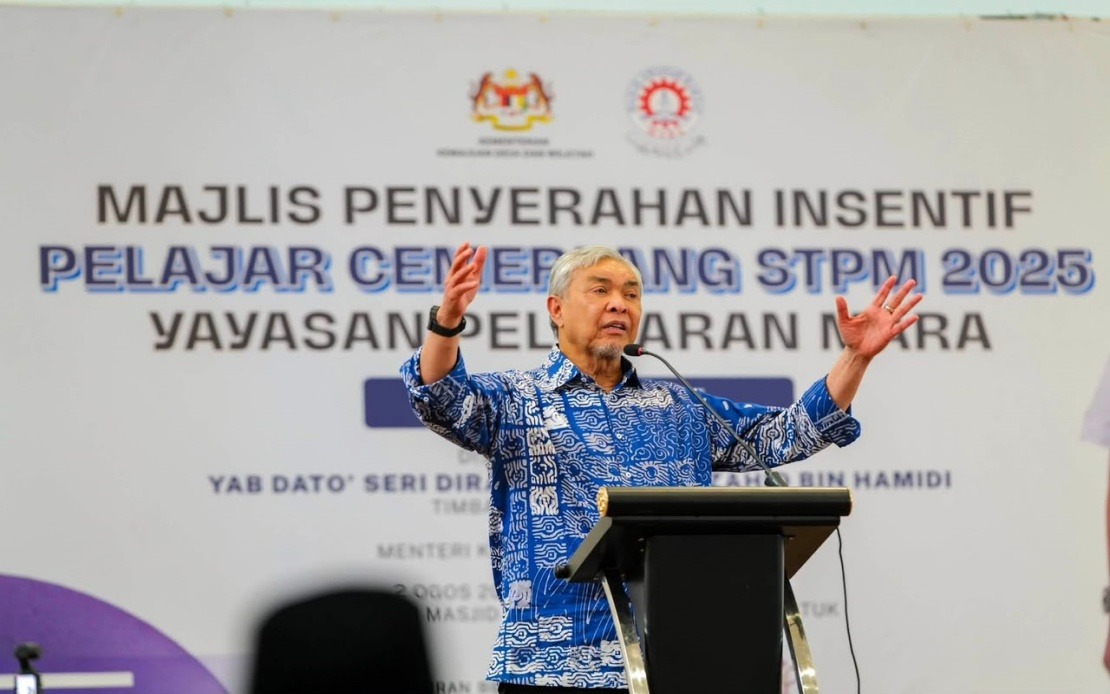
Thirty-eight students from two secondary schools in the Bagan Datuk parliamentary constituency have been honoured by Yayasan Pelajaran MARA (YPM) for their exceptional performance in the 2025 Sijil Tinggi Pelajaran Malaysia (STPM) examination. The students hail from Sekolah Menengah Kebangsaan Khir Johari and Sekolah Menengah Kebangsaan Tun Abdul Razak, both located within the Perak district. The recognition marks a significant acknowledgment of academic excellence in the region and reflects the quality of education being delivered at these institutions.
Deputy Prime Minister Datuk Seri Dr Ahmad Zahid Hamidi, who also serves as the Member of Parliament for Bagan Datuk, announced the awards and highlighted the broader achievements emerging from the constituency. Beyond the STPM excellence incentives, three young individuals from Bagan Datuk have successfully gained admission to Al-Azhar University in Cairo, where they will pursue advanced studies in Islamic Syariah and Usuluddin disciplines. This development underscores the growing international mobility of high-achieving students from the district and their pursuit of specialised religious education at one of the Islamic world's most prestigious institutions.
In addition to the STPM award recipients, the YPM initiative has extended support to 23 other students through its Education Compassionate Fund, a scheme designed to provide financial assistance to deserving pupils facing economic hardship. This layered approach to educational support demonstrates how targeted funding can address both excellence and accessibility, ensuring that financial constraints do not prevent capable students from advancing their studies. The combination of merit-based recognition and need-based assistance reflects a comprehensive strategy to nurture talent across socioeconomic backgrounds.
Dr Ahmad Zahid's statement emphasised the significance of these achievements as evidence of latent potential within Bagan Datuk's youth population. He articulated a conviction that when young people are provided with adequate opportunities, professional mentorship, and institutional backing, they are capable of reaching remarkable academic heights. This perspective aligns with broader national discourse around human capital development and the necessity of creating enabling environments for student success. The recognition of these 38 students serves as a tangible manifestation of this principle in action.
The Deputy Prime Minister positioned education as a foundational investment in individual transformation and community development. His remarks reflected a philosophy that educational advancement transcends personal benefit and holds implications for societal progress. By framing scholarship recipients as future contributors to their district's development, he articulated a social contract wherein education serves as a conduit for upward mobility that ultimately benefits the broader economy and society. This perspective resonates with development priorities across Southeast Asia, where human resource development remains central to national competitiveness.
Dr Ahmad Zahid specifically appealed to parents and guardians to maintain their supportive roles in their children's educational journeys. His emphasis on parental involvement acknowledges research consistently demonstrating that family engagement significantly influences academic outcomes and student motivation. In the Malaysian context, where extended family networks often play substantial roles in child-rearing and education support, this message carries particular resonance. The Deputy Prime Minister's call positioned parental encouragement as a critical success factor alongside institutional and governmental support.
The YPM awards represent part of a broader ecosystem of educational incentives and scholarship schemes operating across Malaysia. Yayasan Pelajaran MARA, established to provide financial assistance to indigenous Bumiputera students, has administered various programmes spanning primary through tertiary education levels. The STPM Excellence Incentive specifically targets high performers in Malaysia's pre-university examination, recognising that merit-based support can complement needs-based assistance in building a strong talent pipeline for higher education and the workforce.
Bagan Datuk's performance in this awards cycle reflects both individual student achievement and the institutional quality of its secondary schools. The concentration of award recipients from just two schools suggests effective teaching methodologies, adequate resources, and institutional cultures that prioritise academic rigour. For comparative context, STPM results across Malaysia vary significantly by school, with performance influenced by teacher quality, student demographics, resource availability, and institutional leadership. The success of Khir Johari and Tun Abdul Razak schools merits recognition of their educators' contributions.
The three Bagan Datuk students gaining admission to Al-Azhar University represent a notable achievement in international higher education placement. Al-Azhar, founded in 970 CE and located in Cairo, ranks among the world's oldest universities and holds particular prestige within Islamic education circles. Admission to its theological programmes is competitive, with international applicants subject to rigorous academic standards. The success of these three students reflects both personal aptitude and the quality of Islamic religious instruction available in Malaysian schools.
The broader implications of these awards extend beyond individual recognition to questions of educational equity and opportunity distribution across Malaysia's districts. Perak has historically received less media attention than larger urban centres like Kuala Lumpur or Selangor in national education discourse, yet achievements such as these demonstrate that excellence emerges across the country when conditions permit. The YPM's investment in Bagan Datuk students contributes to addressing potential geographic disparities in educational outcomes and encourages talent development irrespective of location.
Dr Ahmad Zahid's aspiration for Bagan Datuk youth to pursue higher education domestically and internationally, then return to contribute to district development, articulates a brain-drain concern relevant across Malaysia and Southeast Asia more broadly. Graduate retention and skilled worker recruitment remain challenges for provincial areas facing competition from metropolitan centres offering greater career opportunities and amenities. By investing in student success and envisioning their return, policymakers hope to create virtuous cycles wherein educational investment yields both individual advancement and community benefit.
Moving forward, these recognitions may inspire younger students within Bagan Datuk to pursue academic excellence with greater determination, knowing that tangible rewards and institutional support await high achievers. The visibility of peer success, particularly when amplified through official channels, can influence educational aspirations and behaviours within school cohorts. For Malaysian educators and policymakers, maintaining momentum in supporting excellence while expanding access remains the continuing challenge in building an equitable, merit-driven education system.

