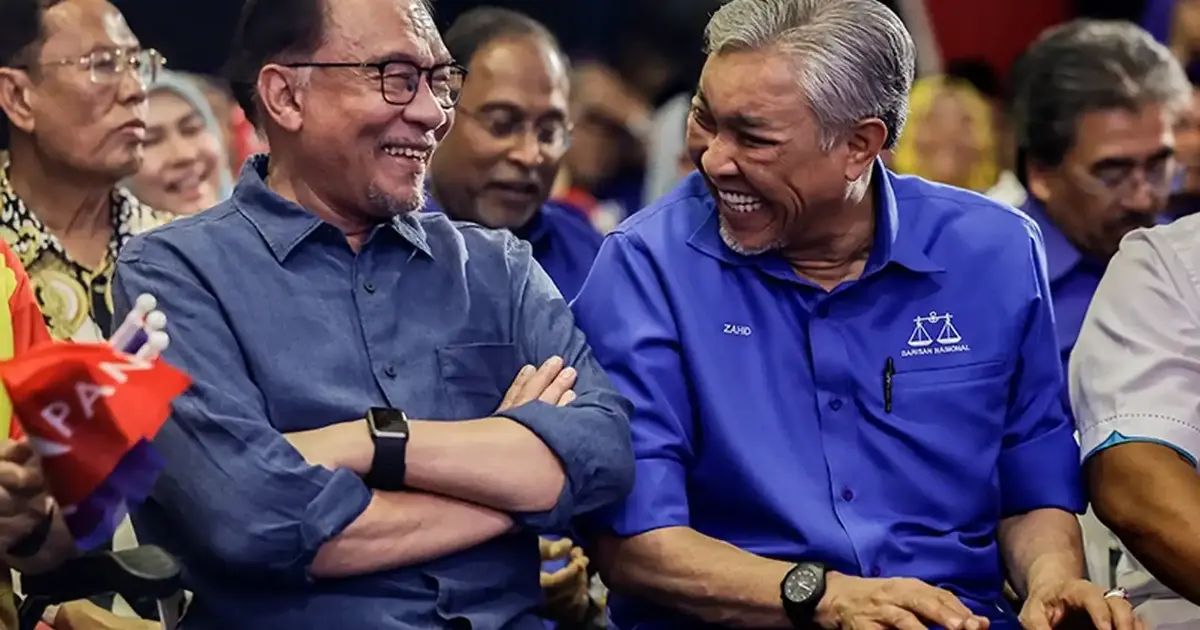
Deputy Prime Minister Ahmad Zahid Hamidi has chosen an unconventional medium to address recent remarks from Prime Minister Anwar Ibrahim, responding with poetry of his own whilst reaffirming the steadfast commitment of Barisan Nasional to Malaysia's coalition government. The poetic exchange marks an intriguing moment in the political dynamics between the two major blocs that together form the foundation of the current administration, highlighting the sometimes theatrical nature of high-level political discourse in Malaysia.
Zahid's response carries particular significance given his dual role as both deputy prime minister and chairman of Barisan Nasional, one of the two principal pillars supporting the unity government framework that has governed Malaysia since late 2022. His decision to reciprocate in poetic form suggests an attempt to inject a measure of levity and cultural sophistication into what might otherwise be perceived as partisan tension between the two coalitions. This choice of communication reflects broader Malaysian political traditions that often blend formal governance with creative expression and symbolic gestures.
The exchange between Anwar and Zahid occurs within the context of Malaysia's ongoing political evolution under the unity government arrangement. This coalition structure, which brought together former political rivals and adversaries, represents one of the most significant political realignments in the nation's recent history. The partnership between Anwar's Pakatan Harapan coalition and Zahid's Barisan Nasional emerged from necessity following the 2022 general election, which produced a hung parliament and necessitated an innovative governance solution.
Barisan Nasional's explicit reaffirmation of its commitment to the unity government carries weight given the coalition's considerable political leverage and the questions that have periodically surfaced regarding the stability and duration of the arrangement. As one of Malaysia's oldest and historically dominant political formations, Barisan Nasional retains substantial representation in Parliament and considerable organisational capacity throughout the country's federal and state structures. Any suggestion of wavering commitment from the coalition could create significant uncertainty about the government's longevity.
The timing of Zahid's statement appears designed to project stability and reassurance to both the market and the Malaysian public, signalling that Barisan Nasional views continued participation in the unity government as strategically advantageous and politically desirable. This messaging becomes particularly important as the government approaches various policy milestones and as it prepares for electoral cycles at state and federal levels. Political uncertainty typically creates economic headwinds, and clearer signals about government continuity can help maintain investor confidence and economic momentum.
For Malaysian readers and observers, the substantive implication of Zahid's commitment is that Barisan Nasional—despite its historical dominance and current parliamentary strength—sees greater value in collaborative governance than in attempting to leverage its position toward an earlier general election or alternative government formation. This represents a notable adjustment from the confrontational postures that characterised Malaysian politics during previous electoral cycles and coalition transitions.
The poetic exchange between the two leaders, whilst light in tone, underscores an important reality of contemporary Malaysian governance: the need for constant communication and relationship management between coalition partners who bring fundamentally different constituencies, ideologies, and historical narratives to the table. The unity government remains without precedent in Malaysia's independent history, requiring ongoing calibration and mutual accommodation between parties that were previously adversaries.
Zahid's emphasis on Barisan Nasional's determination to sustain the coalition until the completion of its constitutional term also carries implications for Malaysia's institutional development. It suggests a preference for completing the full parliamentary cycle rather than engaging in the frequent snap elections that have characterised recent Malaysian political history, potentially allowing the government greater opportunity to implement longer-term policy initiatives and demonstrate governance achievements to voters.
The exchange also reflects the distinctive character of Malaysian political communication, where cultural references, rhetorical flourishes, and symbolic gestures often carry substantive political meaning. By matching Anwar's poetic contribution with verse of his own, Zahid simultaneously addresses the specific remarks while demonstrating wit and cultural literacy—qualities that hold particular resonance within Malaysia's educated political class and broader public discourse.
Looking forward, statements such as Zahid's serve an important stabilising function within a still-maturing coalition government. Clear public commitments from coalition leaders regarding the government's durability help reduce speculation about alternative arrangements and create space for the administration to focus on substantive policy matters rather than constantly addressing questions about its survival. For Southeast Asian observers, Malaysia's unity government experiment continues to represent an important case study in coalition governance and power-sharing arrangements in a diverse, multi-ethnic democratic setting.

