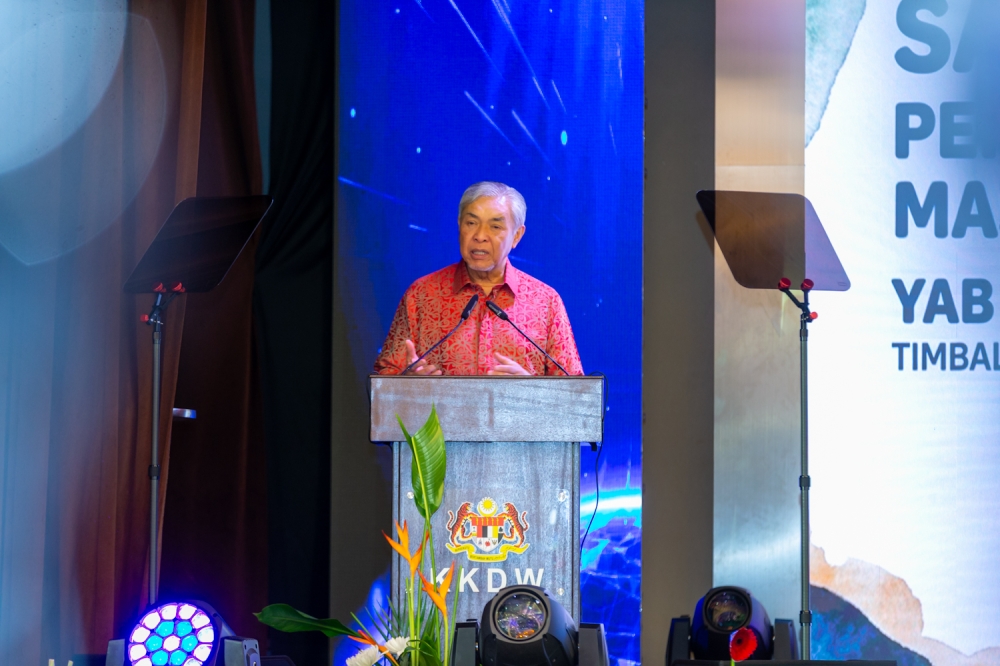
Deputy Prime Minister Datuk Seri Ahmad Zahid Hamidi has categorically rejected widespread claims circulating on social media suggesting that senior leaders from Barisan Nasional, Perikatan Nasional, GPS, and GRS held secret negotiations. Speaking in Putrajaya on July 21, Zahid moved swiftly to quash the speculation that has been spreading across Malaysian political circles, emphasizing instead his unwavering commitment to maintaining and strengthening the current unity government framework.
The rumours, which gained traction online in recent days, alleged that representatives from these major political coalitions were engaged in behind-the-scenes discussions potentially aimed at reshaping Malaysia's political landscape. Such claims, if credible, would have represented a seismic shift in the country's political architecture, given that several of these coalitions currently occupy opposing benches in Parliament. The suggestion of informal talks between these competing blocs touched on longstanding speculation about possible realignments in Malaysian politics.
Zahid's categorical denial represents more than a simple factual correction. His statement reflects the delicate balancing act required to maintain the unity government, which has been Malaysia's governing framework since 2020 and has weathered numerous challenges to its stability. The coalition, comprising diverse parties with sometimes conflicting interests, requires constant reassurance to its members that the arrangement remains the preferred political direction. Any perception that senior figures were exploring alternative configurations could have seriously undermined confidence in the current administration.
The Deputy Prime Minister's reaffirmation of support for the unity government carries particular weight given his position as the second most senior government figure and his standing within UMNO, Barisan Nasional's largest component party. His statement serves as an important signal to both coalition partners and potential dissidents within his own party that the current political arrangement enjoys backing from the highest levels of government leadership. This messaging is crucial at a time when various political forces continue to test the stability of the existing coalition.
The timing of these viral claims raises questions about their origins and motivations. In Malaysian politics, such rumours often emerge during periods of policy disagreements or when intra-coalition tensions surface. They may reflect genuine discussions at lower political levels, be deliberately planted to test political reactions, or arise from misinterpretations of routine inter-party meetings. Zahid's swift response suggests that government leadership took the reports seriously enough to warrant immediate clarification rather than allowing them to fester.
The unity government itself represents a historic coalition between ideologically diverse parties brought together by the need for political stability following the 2018 general election and its aftermath. Barisan Nasional, the traditional ruling coalition, joined forces with Pakatan Harapan and other parties to prevent a return to single-party dominance or political fragmentation. This arrangement has survived multiple challenges, including internal defections, policy disagreements, and disagreements over electoral strategies. However, it remains fundamentally fragile, dependent on the continued commitment of all major parties to the concept of coalition governance.
GPS, which controls Sarawak's state government, and GRS, based in Sabah, represent crucial components of the unity government's parliamentary majority. These East Malaysian parties have strategically positioned themselves as kingmakers in national politics, leveraging their bloc votes to maintain influence despite their smaller overall representation. Any suggestion that they were exploring alternative alignments with Perikatan Nasional—a coalition that has positioned itself as an opposition force in most contexts—would have complicated the government's legislative agenda and parliamentary arithmetic.
Perikatan Nasional, meanwhile, has emerged as a significant force in Malaysian politics, particularly following its strong performance in several state elections. The coalition includes Parti Islam Se-Malaysia and various other parties, positioning itself as an alternative to both Barisan Nasional and Pakatan Harapan. Speculation about Perikatan Nasional negotiating with other blocs reflects broader anxieties about the stability of Malaysia's political system and whether the current configuration can endure until the next general election.
Zahid's statement also implicitly addresses concerns among Barisan Nasional members themselves. Some UMNO figures have, in the past, suggested that the party might be better served by reconstructing a coalition primarily with Perikatan Nasional and other Malay-Muslim-based parties, rather than maintaining partnerships with DAP and other Pakatan Harapan components. These internal debates, while largely kept below the surface, periodically threaten the unity government's cohesion. By publicly reaffirming his commitment to the current arrangement, Zahid signals that UMNO's senior leadership views the unity government as the appropriate political framework.
For Malaysian readers and Southeast Asian observers monitoring the country's political trajectory, Zahid's intervention underscores the continued volatility of Malaysia's political environment. While the unity government has achieved relative stability in legislative terms, its fundamentally coalition-based character means that periodic tensions and realignment speculation are virtually inevitable. The question is not whether such pressures will emerge, but whether successive government leaders will continue to actively manage and contain them.
The rejection of these claims also reflects a broader calculation about the costs and benefits of various political configurations. The unity government, despite its challenges, has provided sufficient benefits to its constituent parties—in terms of ministries, allocations, and political legitimacy—that most leaders prefer its continuation over the uncertainty of pursuing alternative alignments. However, this preference depends on continued delivery of tangible benefits and maintenance of relative comity among coalition partners, both conditions that remain perpetually contested.

