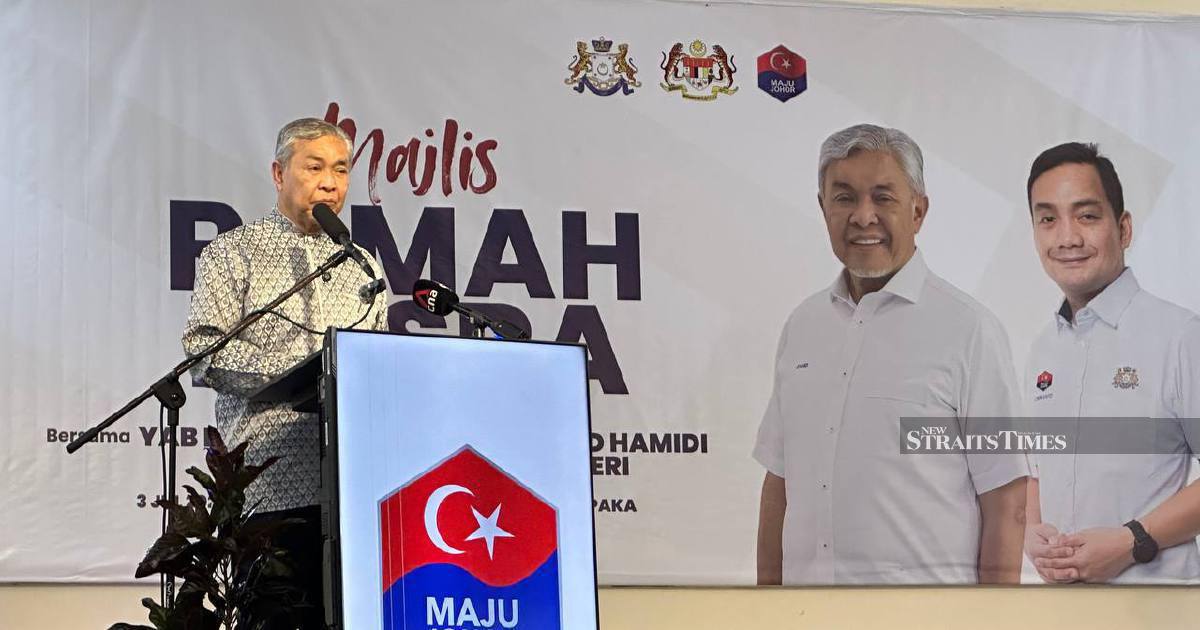
Barisan Nasional chairman Datuk Seri Dr Ahmad Zahid Hamidi has made a direct appeal to coalition partners in the unity government, requesting they abandon efforts to dredge up historical grievances against Umno and the broader BN coalition as polling approaches in Johor. The remarks, delivered in Johor Baru, underscore mounting concerns within Umno's leadership over the fragile cohesion that underpins Malaysia's current governing arrangement.
Zahid's intervention reflects the delicate balance Malaysia's political landscape has required since the formation of the unity government. The coalition bringing together Barisan Nasional, Pakatan Harapan, and other partners represents a pragmatic realignment aimed at preventing political instability, yet it remains fundamentally a marriage of convenience between parties that have spent years at each other's throats. The upcoming Johor election, a crucial state battleground in a region Umno has traditionally dominated, appears to have heightened tensions beneath the surface cordiality of the arrangement.
For Umno specifically, the call for restraint carries particular weight given the party's recent history. The coalition has faced repeated questioning over governance standards, financial management, and the personal legal circumstances of its senior figures. These matters remain contentious within segments of the Malaysian electorate and continue to feature in political discourse. By appealing for allies to cease raising such issues, Zahid appears to be requesting that competing parties agree to ringfence certain topics during the campaign period to preserve government stability.
The timing of Zahid's statement is strategically significant. Johor represents one of Malaysia's most economically important states and has served as a traditional stronghold for Umno's political power. A campaign marred by public recriminations between coalition partners could undermine unified messaging and potentially embolden opposition forces seeking to capitalise on any perceived disunity. The state election offers the unity government an opportunity to demonstrate its capacity to govern effectively despite its ideological differences.
Political analysts in Malaysia have noted that the stability of the current governing arrangement depends substantially on the restraint all coalition members exercise regarding historical disputes. The unity government framework essentially requires participants to suppress traditional campaign tactics that might otherwise prove effective but would damage the broader coalition's credibility. This structural tension between competitive electoral politics and the necessity for governmental cooperation creates persistent friction within the arrangement.
For Malaysian voters, particularly those in Johor, Zahid's plea raises questions about the authenticity of political competition within the unity government framework. Opposition parties have already begun framing the arrangement as one where serious criticism of ruling coalition members becomes off-limits during campaigns. The expectation that allies will refrain from raising substantial governance questions potentially limits the public discourse available to voters during election periods.
The broader Southeast Asian context also matters here. Malaysia's unity government represents a rare experiment in coalition politics at the national level, drawing attention from regional observers interested in whether competing parties can genuinely cooperate while maintaining democratic processes. The outcome of the Johor election and the cohesion demonstrated throughout the campaign may signal whether such arrangements can survive in the region or whether they remain inherently unstable.
Umno's position within this arrangement requires particularly careful navigation. As the largest component of Barisan Nasional and historically the dominant force in Malaysian politics, the party risks appearing weakened if it cannot address criticism independently or if it appears subordinate to Pakatan Harapan components within the unity framework. Conversely, aggressive defence of party interests risks destabilising the entire government, given how narrow parliamentary majorities have become.
The practical implications for Johor voters remain unclear. Whether coalition partners actually honour Zahid's request during the campaign season will demonstrate whether the unity government can maintain message discipline when electoral pressures mount. The state election serves as a test case for whether Malaysia's governing arrangement possesses sufficient institutional maturity to weather genuine competitive elections while maintaining governmental functionality.
Zahid's statement ultimately reflects the fundamental paradox at the heart of Malaysia's current political system: the requirement for stability through coalition unity directly contradicts traditional notions of vigorous democratic competition. His appeal to coalition partners essentially asks them to moderate their political behaviour in ways that may run counter to their electoral interests. How successfully all parties navigate this tension will significantly influence both the Johor election outcome and the longer-term viability of unity government arrangements in Malaysia.

