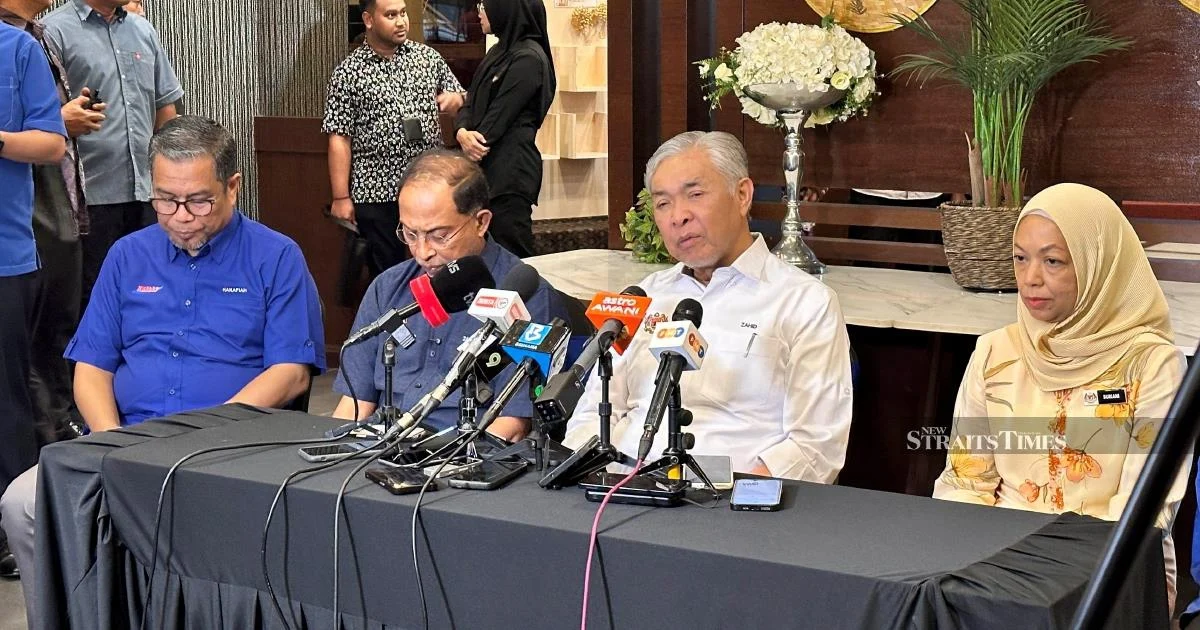
Barisan Nasional chairman Datuk Seri Dr Ahmad Zahid Hamidi has signalled frustration with coalition partners over their continued engagement with contentious figures from Malaysia's recent political past, specifically admonishing the use of Datin Seri Rosmah Mansor's image in the Johor election campaign. The remarks, delivered in Kluang, underscore mounting tensions within the unity government as different component parties navigate the delicate balance between legacy issues and forward momentum heading into a crucial state electoral contest.
The implicit rebuke points to divisions within the broader government alliance over campaign strategy in Johor, where the BN has traditionally maintained strong electoral dominance. Some coalition members appear to be invoking associations with prominent former figures, presumably for their continued influence among certain voter constituencies, a tactic that Zahid's intervention suggests carries risks for the unified electoral effort. The decision by a partner party to feature imagery tied to Rosmah—whose husband, former Prime Minister Datuk Seri Najib Razak, remains imprisoned following convictions in high-profile corruption cases—represents a calculated political choice with potential ramifications for overall coalition messaging.
For Malaysian voters, particularly in Johor, such internal squabbles highlight unresolved tensions within the ruling coalition structure. The unity government, formed after the 2022 general election, has positioned itself as a stabilizing force providing broad-based representation. Yet disagreements over which historical figures and symbols to emphasize reveal that member parties continue to pursue distinct political narratives and constituencies, sometimes at cross-purposes. Zahid's intervention attempts to enforce message discipline by directing attention away from controversial personalities and toward present-day governance achievements and future policy commitments.
The invocation of Rosmah and Najib carries particular weight in Johor, where Najib served as mentri besar for two decades before becoming Prime Minister, cultivating deep local networks and associations. Some BN affiliates may view references to this legacy as effective in mobilizing traditional supporters who recall that era as one of relative stability and development investment. However, the couple has become synonymous with the 1Malaysia Development Berhad (1MDB) scandal and subsequent investigations that shook public confidence in governance standards, making their deployment in contemporary campaigns a doubled-edged proposition.
Zahid's call for partners to "move on" reflects recognition that sustained focus on these figures risks alienating swing voters and younger constituencies seeking assurance that the current administration represents genuine reform. By explicitly criticizing the use of Rosmah's image, the BN chairman attempts to reposition the coalition around institutional credibility rather than personality-driven politics. This strategic recalibration matters significantly for Southeast Asian observers, as Malaysia's political trajectory influences regional perceptions of institutional resilience and democratic maturity.
The tension also illustrates broader challenges facing multi-party coalitions in maintaining operational cohesion. The unity government comprises multiple entities with divergent interests, organizational cultures, and electoral calculations. While unified opposition to Islamic State-aligned parties provided initial bonding, coalition members increasingly pursue independent advantages, particularly in state-level contests where electoral fortunes vary. Johor, as a bellwether state historically, amplifies these underlying fractures and exposes the coordination difficulties inherent in the coalition structure.
From a campaign perspective, Zahid's intervention signals that senior BN leadership views the invocation of controversial figures as strategically counterproductive. The statement effectively tells smaller coalition partners that leveraging Rosmah's image will not receive organizational blessing and may face pushback from the party hierarchy. Such messaging discipline remains essential for preventing the narrative from fragmenting into competing historical reckonings during a critical electoral moment. Without unified messaging, Johor voters receive conflicting signals about what the coalition stands for and its relationship with its own past.
The implicit disagreement also touches on generational divides within Malaysian politics. Older voters with direct memories of Najib's tenure may respond positively to his legacy, while younger, digitally-engaged citizens approach such references with skepticism or outright hostility given the criminal convictions and perceived institutional failures they symbolize. A coalition pursuing across-generational appeal must navigate these fault lines carefully, and Zahid's rebuke reflects awareness that emphasizing contested historical figures alienates faster-growing demographic segments.
Moving forward, how coalition members respond to this directive will indicate whether message discipline can be maintained through the Johor campaign. Defiance would signal deepening fissures; compliance would suggest that BN authority remains intact. Either way, the incident demonstrates that despite government control and institutional advantages, Malaysian politics continues to grapple with how to process recent controversial history while building forward momentum. For regional observers, the episode reinforces that Southeast Asian democracies remain works in progress, managing internal contradictions between institutional modernization and entrenched networks shaped by previous political eras.

