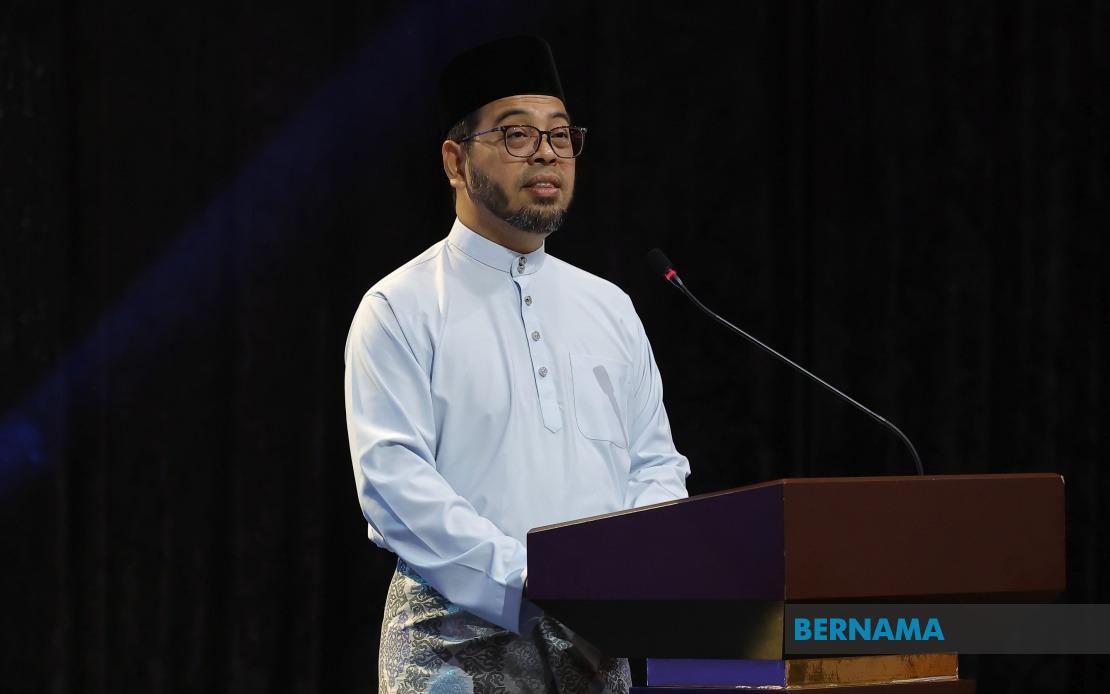
Dr Zulkifli Hasan, the Minister in the Prime Minister's Department (Religious Affairs), has called upon Malaysia's Muslim population to transcend internal conflicts and cultivate greater unity within the ummah, particularly as the country confronts an increasingly intricate global landscape. Speaking at the national Maal Hijrah 1448H/2026M celebration held at Putra Mosque in Putrajaya on June 17, the minister contended that resolving longstanding grievances among Muslim communities is fundamental to strengthening the collective fabric of Malaysian society.
The ceremony, which carried the thematic message "MADANI Dihayati, Ummah Diberkati" (MADANI Lived, Ummah Blessed), was attended by prominent dignitaries including the Sultan of Perak, Sultan Nazrin Shah, and Deputy Prime Minister Datuk Seri Fadillah Yusof. This high-level participation underscored the significance accorded by Malaysia's political leadership to fostering community cohesion during a period of complex international pressures.
Zulkifli emphasised that meaningful social transformation extends beyond policy implementation and requires fundamental individual renewal encompassing intellectual growth, spiritual development, and moral refinement. The minister's perspective reflects a deeper understanding that systemic change in society must be grounded in the transformation of individual conscience and commitment. By framing unity as contingent upon personal growth, he articulated a vision where communal strengthening emerges from accumulated individual ethical development rather than top-down institutional mandates alone.
The minister articulated a stark contrast between the outcomes of unity and division, arguing that a cohesive community generates prosperity and blessings for all constituents, while fragmentation precipitates hardship and diminishes national resilience. This framing carries particular relevance for Malaysia, a multi-ethnic and multi-religious nation where religious cohesion among the Muslim majority has historically underpinned broader social stability. The minister's rhetoric suggests that discord within the Muslim community carries implications that extend beyond religious circles to affect the broader nation-building project.
Globalised economic disruptions and supply chain vulnerabilities have created conditions of uncertainty affecting nations throughout Southeast Asia and beyond. Zulkifli situated Malaysia within this broader context of vulnerability, arguing that hearts united through collective purpose and mutual commitment represent a critical asset as the country navigates external shocks. This framing connects local religious unity to Malaysia's capacity to maintain economic stability and social cohesion amid international volatility—a particularly pertinent concern for a nation whose prosperity is substantially dependent on global trade and investment flows.
The minister explicitly appealed to Malaysians to sustain backing for government initiatives designed to enhance the standing of Muslims and ensure that Islamic principles remain vibrant within the Malaysian context. This formulation suggests that supporting government initiatives represents a practical expression of religious commitment and community solidarity. By linking governmental programmes to Islamic values advancement, Zulkifli presented state action and religious aspiration as complementary rather than competing objectives.
Expanding upon the classical Islamic concept of hijrah—traditionally understood as migration in service of religious conviction—Zulkifli reframed the concept as an ongoing personal and communal journey characterised by abandoning detrimental behaviours and nurturing virtues that reinforce social cohesion. This contemporary interpretation renders hijrah relevant to modern believers regardless of geographical displacement, transforming it into a metaphor for continuous spiritual renewal and ethical development. The reframing demonstrates how traditional Islamic concepts can be mobilised to address contemporary social challenges while remaining grounded in classical Islamic theology.
The minister contended that effective implementation of initiatives aimed at elevating and preserving Islamic values fundamentally depends upon the prior achievement of community unity. This sequential logic—unity precedes efficacy—suggests that divisive attitudes within the Muslim community actively obstruct the realisation of religious and social objectives. By establishing this causal link, Zulkifli implied that sectarian disputes, doctrinal disagreements, or leadership rivalries represent not merely internal inconveniences but concrete impediments to tangible progress on matters of communal concern.
Simultaneously, Zulkifli acknowledged that notwithstanding distinct belief systems and diverse backgrounds, all Malaysian citizens shoulder shared responsibility for maintaining peace, stability, and prosperity throughout the nation. This inclusive framing, which extends beyond the Muslim community to encompass citizens of all faiths, suggests a vision where religious cohesion contributes to but does not monopolise the foundations of national unity. The acknowledgment of shared citizenship responsibilities indicates an attempt to balance appeals for Muslim solidarity with recognition of Malaysia's pluralistic composition.
The ceremonial awarding of honours underscored the occasion's significance. The National Tokoh Maal Hijrah award was conferred upon Prof Emeritus Datuk Dr Osman Bakar, rector of the International Islamic University Malaysia (IIUM), recognising his contributions to Islamic scholarship and institutional leadership within Malaysia. The International Tokoh Maal Hijrah award presented to Moroccan Islamic scholar Dr Ahmad Al-Raysuni acknowledged intellectual contributions to Islamic thought emerging from beyond Malaysia's borders, suggesting that strengthening the ummah encompasses engagement with Islamic scholarship and leadership across geographical boundaries.
The timing of these remarks, delivered as Malaysia navigates economic uncertainties and social complexities, reflects deliberate positioning of religious unity as a strategic national resource. Rather than treating ummah solidarity as an end in itself, the minister's articulation connects communal cohesion to tangible outcomes including economic resilience, effective governance, and social stability. For Malaysian policymakers and religious leaders, the challenge ahead involves translating these appeals for unity into concrete institutional mechanisms and practical governance approaches that can channel collective commitment toward addressing the substantive challenges confronting the nation.