Police in Phu Tho province announced Thursday that they have filed criminal charges against four individuals suspected of orchestrating a cross-border scheme to transplant a large-scale online fraud operation from Cambodia into northern Vietnam. The investigation revealed an intricate network designed to exploit regulatory gaps between neighbouring countries, with foreign-based crime syndicates seeking refuge as authorities intensified enforcement against cybercriminals.
The plot centred on relocating personnel and infrastructure from Cambodian-based scam operations, which have become a significant regional concern. Investigators determined that the group had decided to shift activities eastward into Vietnam after facing mounting pressure from Cambodian law enforcement. This pattern reflects a broader trend among transnational fraud networks that pivot their bases when jurisdictions tighten security measures, often exploiting porous borders and inconsistent enforcement capacities across Southeast Asia.
Charge sheet documents identified Zhao Wei Zhong, a 37-year-old Chinese national, as the primary architect of this relocation strategy. Intelligence indicated that Zhao had entered Vietnam under explicit instructions from overseas handlers who coordinated the broader criminal enterprise. His role was instrumental—tasked with establishing the foundational logistics required to welcome dozens of foreign employees once they could be transported across the border from Cambodia into Vietnamese territory.
Zhao's background in the fraudulent industry proved valuable to conspirators. He had previously spent time managing operations at Chinese-controlled scam facilities in Cambodia, providing him with both practical knowledge and personal connections to other criminals. During his time there, he cultivated relationships with two Vietnamese accomplices: Tran Thi Thu Huong, 24, from Bac Ninh province, and Dình Nam, 27, also based in Bac Ninh. These partnerships were essential, as local operatives could navigate the regulatory environment more easily than foreign nationals.
Once established in Vietnam, Zhao systematically recruited the pair to facilitate the transition. Huong and Nam were assigned roles that leveraged their domestic status and linguistic abilities. Huong's translation skills proved critical for coordinating with incoming Cambodian-based workers, whilst Nam provided logistical support through driving services and scouting suitable properties. Together, they identified and evaluated residential locations that could accommodate the expected influx of foreign employees, ensuring the infrastructure would be ready upon their arrival.
A fourth conspirator, 43-year-old Hanoi resident Nguyen Thanh Long, contributed further operational support. Long's role focused on arranging broader logistical components necessary to establish the fraudulent call centre. His involvement suggests the network had cultivated multiple layers of assistance, distributing tasks across different individuals to compartmentalise knowledge and reduce individual exposure to detection.
Vietnamese law enforcement agencies successfully interrupted the operation before it reached operational maturity. Officers detected the scheme during its preparatory phase, disrupting the transfer of personnel and infrastructure before the scam centre could commence activities on Vietnamese soil. This intervention prevented what could have become a significant expansion of online fraud capacity within the country.
Investigators formally charged Zhao, Huong, and Long on June 17 with organising the illegal residence of foreign nationals in Vietnam—the primary criminal statute applicable to harbouring undocumented foreign workers engaged in illegal activities. All three were ordered held in pretrial detention pending trial proceedings. Nam faced identical charges but received different treatment; authorities placed him under a movement restriction order rather than custody, effectively confining him to his residence while investigations continue.
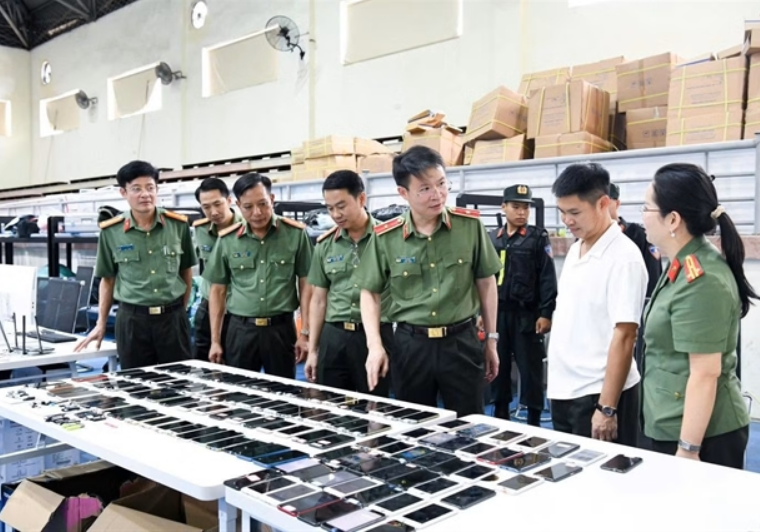
Physical evidence recovered from properties linked to the suspects underscores the scale of intended operations. Police seized 73 computers, 134 mobile phones, 34 USB storage devices, 20 Wi-Fi routers, and additional telecommunications equipment allegedly designated for the scam call centre. This substantial cache of devices indicates the network had invested considerable resources and intended to operate a sophisticated fraud facility capable of managing numerous simultaneous scams.
The discovery highlights vulnerabilities in border security and inter-provincial coordination across Southeast Asia. Online fraud operations continue migrating between countries as enforcement pressures mount, exploiting the region's developing law enforcement capacities and occasionally inconsistent extradition arrangements. For Malaysian readers and authorities, this case demonstrates how criminal networks operating in neighbouring countries can pose indirect risks, particularly regarding money laundering flows and telecommunication abuse that may route through Malaysian networks.
The investigation reflects growing regional cooperation against cybercrime, yet also exposes persistent gaps. Vietnam's success in this instance stems from dedicated intelligence work and proactive detection before criminal infrastructure became fully operational. However, similar operations likely continue across Southeast Asia, with smaller networks successfully evading detection or operating in jurisdictions with weaker enforcement mechanisms.
Vietnam's action signals strengthened resolve against both domestic and imported fraud operations. The charges carry significant penalties under Vietnamese law, potentially resulting in lengthy imprisonment for all four defendants. Authorities have indicated their commitment to pursuing both the conspirators and the overseas handlers directing these operations, though prosecuting foreign-based organisers remains jurisdictionally complex.

