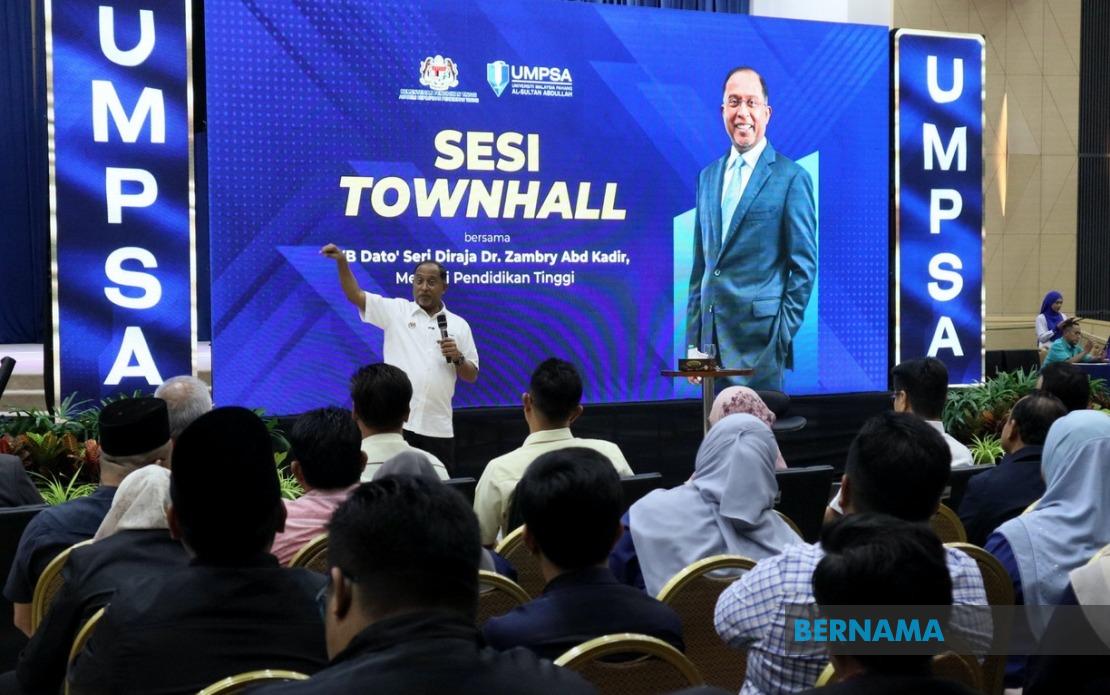
The Ministry of Higher Education (KPT) is moving swiftly to operationalise Prime Minister Datuk Seri Anwar Ibrahim's recent directive concerning the handling of student disciplinary matters within Malaysian universities. The decision represents a significant pivot in how tertiary institutions manage cases involving student conduct, with particular focus on students previously penalised for expressing views critical of the government. Minister Datuk Seri Dr. Zambry Abd Kadir announced the follow-up measures during an address at Universiti Malaysia Pahang Al-Sultan Abdullah (UMPSA) in Pekan, signalling that the government is treating the matter with urgency despite the complex regulatory landscape surrounding university governance in Malaysia.
The directive addresses a fundamental tension that has long existed within Malaysia's higher education ecosystem: the balance between maintaining institutional discipline and protecting academic freedoms. Dr. Zambry emphasised that the ministry's approach incorporates considerations at both the regulatory and legislative levels, acknowledging that any disciplinary reforms must respect the existing framework governing university operations. This dual approach reflects the complexity of reforming student conduct policies, which are often deeply embedded within institutional bylaws and procedures developed over decades. The minister noted that the initiative encompasses several interconnected matters, suggesting that the government recognises this is not simply a matter of issuing blanket pardons but rather a comprehensive review of how disciplinary mechanisms operate across the higher education sector.
A critical development emerged from an all-day meeting convened between KPT leadership, the director-general of Higher Education, and vice-chancellors from public universities across Malaysia. This high-level engagement signals the magnitude of the reform effort and indicates that university leadership is being brought into direct conversation about implementation strategies. The participants are expected to release a formal statement outlining the pathway forward, which will likely provide clarity to students, staff, and institutional administrators about how the new approach will function in practice. This coordinated response from the leadership level suggests an attempt to ensure consistency across Malaysia's public university system, avoiding a fragmented implementation that could create confusion or inequities between institutions.
Prime Minister Anwar's original statement at the Malaysia Madani Intellectual Forum Series 13 provided the intellectual framework for these actions, explicitly calling for the exoneration of students who had faced disciplinary consequences for criticising the government. This represents a departure from previous practices and reflects the government's stated commitment to democratic values and open discourse. However, Anwar was careful to distinguish between university-level disciplinary matters and cases involving criminal proceedings under Royal Malaysia Police oversight. This demarcation is crucial because it clarifies that while the government is willing to overturn university-administered sanctions, it is not offering immunity from criminal law—a distinction that maintains legal coherence while advancing the academic freedom agenda.
The prime minister's initiative draws legitimacy from the broader movement to reform the Universities and University Colleges Act (AUKU) 1971, a decades-old legislation that has long been criticised for restricting student political expression and organising capacity. The AUKU, enacted during an earlier political era, has been viewed by academics, civil society, and many students as fundamentally limiting the kinds of healthy democratic participation expected in modern universities. By linking the student exoneration directive to the anticipated AUKU repeal, the government is positioning these actions within a larger reform narrative aimed at modernising Malaysia's approach to student rights and university autonomy. However, the government has acknowledged that formal legislative amendments typically proceed at a slower pace than executive directives, necessitating the interim measure of absolution for previously disciplined students.
A practical complexity emerges when considering Malaysia's mixed higher education landscape, which includes both public institutions fully under government purview and private colleges governed by different regulatory frameworks. Dr. Zambry acknowledged that private higher education institutions operate under the Private Higher Educational Institutions Act 1996 (Act 555), creating a distinct legal status that limits the KPT's direct authority over their disciplinary procedures. This recognition is important for transparency—the minister did not attempt to overstate the ministry's reach or create false expectations about universal implementation. Nevertheless, the government is signalling a strong preference that private institutions, particularly those with state ownership or connections, voluntarily adopt the same disciplinary review approach. This appeal to institutional responsibility represents a soft-power strategy that respects legal distinctions while leveraging the government's moral and political authority.
The timing of this directive coincides with broader efforts to strengthen governance in Malaysia's universities, including ongoing discussions about how tertiary institutions should balance autonomy with accountability. For Malaysian readers and observers across Southeast Asia, the significance lies in what this signals about the trajectory of democratic governance in the region's largest Muslim-majority democracy. Universities are often leading indicators of political climate; reforms expanding student voice and limiting restrictions on expression suggest a government confident enough to permit dissent within educational spaces. Conversely, the careful demarcation preserving police powers over criminal matters indicates the government is not abandoning all mechanisms of social control, but rather recalibrating where such controls are appropriately applied.
The student population affected by this policy—including those who faced previous disciplinary action for political expression—represents a significant constituency whose experience will shape narratives about Malaysia's commitment to democratic values. These students and their peers will be monitoring whether the announced reforms translate into genuine changes in institutional behaviour or remain symbolic gestures. Faculty members and university administrators will face the practical challenge of implementing new norms while managing potential institutional resistance from colleagues invested in older disciplinary cultures. The success of this directive will therefore depend heavily on how thoroughly the promised statement from university leadership translates into operational guidance and how rigorously compliance is monitored and enforced.
For Southeast Asia's higher education sector more broadly, Malaysia's approach offers a test case in how governments can reform university governance in response to calls for expanded academic freedom. The region has witnessed recurring tensions between state authority and institutional autonomy, with some nations implementing severe restrictions on university political engagement while others have gradually loosened controls. Malaysia's incremental approach—using executive directives to test reforms before full legislative change—reflects pragmatic politics but also creates inherent uncertainties. International observers and regional peer institutions will be watching whether these reforms endure through subsequent political transitions and whether they meaningfully expand the practical space for student and faculty expression.
The broader policy landscape reveals an emerging consensus in Malaysian government circles that restrictive student regulations represent a legacy policy requiring recalibration. The explicit mention that absolution of previous offences should occur immediately, despite the longer timeline for legislative amendments, demonstrates prioritisation of student justice over administrative convenience. This sequencing sends a powerful signal that the government is willing to grant remedies before completing the full legislative architecture supporting reform. However, the distinction between absolution at the university level and immunity from criminal charges creates a residual legal uncertainty that could potentially complicate implementation and may require further clarification as specific cases emerge.
The convening of 500 young lecturers and administrators at the Kembara KARISMA Pemimpin Muda MADANI programme alongside the announcement of these disciplinary reforms appears deliberate—positioning the next generation of academic leadership as stakeholders in the modernisation project. By engaging younger faculty and administrators in dialogue about institutional change, the government and KPT are attempting to cultivate advocates for the new approach within universities themselves. This generational dimension suggests recognition that sustainable reform requires buy-in from those who will lead institutions in coming years, not merely compliance from current administrators. The geographic focus on eastern Malaysia—Pahang, Terengganu, and Kelantan—also reflects an effort to ensure that reforms reach beyond peninsular universities and encompass the broader national system.
Implementation challenges will inevitably emerge as universities operationalise these directives. Questions about how to handle students whose cases have already concluded, how to calculate any remedies or record-clearing processes, and how to ensure consistency across institutions will require detailed guidance. The promised statement from university leadership may address some of these issues, but the regulatory complexity means that interpretation of the directive's scope will likely generate ongoing discussion. Malaysian universities have historically demonstrated considerable autonomy in how they interpret central directives, suggesting that implementation may vary somewhat across institutions despite centralised policy intent. This variability itself will become part of the accountability landscape, with civil society organisations, student unions, and media likely monitoring whether proclaimed reforms become genuine institutional practice.

