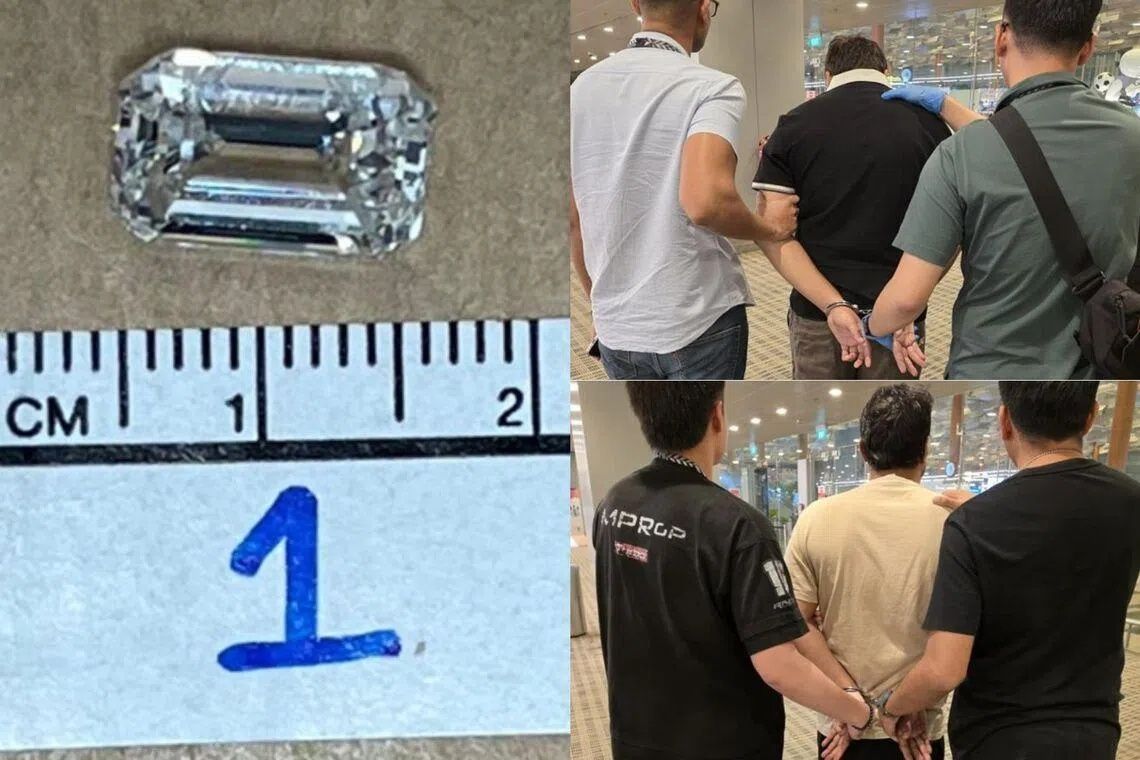
A meticulously planned jewellery heist at a Chinatown store in Singapore has resulted in a prison sentence for one of two Indian nationals involved in the brazen theft. Mangroliya Manojkumar Kurjibhai, 41, received a custodial term of two years, two months and two weeks after pleading guilty to stealing a 4.95-carat diamond valued at approximately S$200,000 from Dianoche jewellery store on Kreta Ayer Road. His accomplice, Serasiya Milan Ramnikbhai, 30, remains awaiting trial on related charges, with both men arrested at Changi Airport within hours of committing the crime.
The operation, which unfolded with calculated precision on June 19, involved extensive pre-planning that crossed international borders. The duo orchestrated the theft from India, where they commissioned a counterfeit diamond that precisely matched the specifications and serial number of the genuine gemstone they intended to steal. This level of preparation suggests the pair had studied their target carefully, though court documents did not reveal how they had identified the valuable diamond or obtained detailed information about its characteristics. The sophistication of their planning stood in sharp contrast to their swift apprehension, highlighting both the boldness and ultimate futility of their scheme.
According to State Prosecuting Officer Yip Cheng Yee's account to the court, the two men executed their plan on the same day they arrived in Singapore. Both tourists entered the Dianoche store around 3pm, with Serasiya concealing the counterfeit diamond inside his mouth—a method designed to avoid detection during any preliminary security checks. Mangroliya then requested to examine the genuine 4.95-carat diamond, valued at over US$154,000, initiating a series of calculated interactions with the store's sales manager.
The theft operation relied on a simple but effective distraction strategy. Mangroliya repeatedly asked the sales manager to retrieve additional items for inspection, forcing the employee to leave his position multiple times during the transaction. This created the necessary window of opportunity for the swap. At a prearranged moment, Mangroliya signalled his partner, who extracted the fake diamond from his mouth and produced the real gemstone in its place. The genuine diamond was immediately secreted in Serasiya's mouth, leaving the fake in its place on the counter.
To reinforce their cover story and avoid raising immediate suspicion, Mangroliya then informed the sales manager they would consider purchasing the item but needed time to deliberate. The pair casually departed the store, apparently confident in their execution. However, the store's security infrastructure proved decisive. CCTV footage captured the entire exchange, providing crystal-clear evidence of their actions. When the manager subsequently examined the diamond left behind using an optical gemstone identification machine, the deception became immediately apparent. The stone in the display case was conclusively identified as a counterfeit.
The criminals' attempt to flee Singapore unfolded rapidly but ultimately proved unsuccessful. After leaving the jewellery store, both men proceeded to their hotel, where they checked out and made their way to the airport to board an evening flight to India. Their plan appeared to be executing flawlessly, with no immediate indication that authorities had identified them or were aware of the theft. The speed of their movements suggested they intended to clear Singapore airspace before any alarm could be raised.
Their calculations proved fatally flawed. Officers stationed at Changi Airport Terminal 3 apprehended both men around 9pm that evening, just as they were attempting to pass through immigration control. The arrest denied them the final step of their escape. Upon being detained, the genuine diamond was recovered from Serasiya's haversack, effectively closing the case. The evidence was overwhelming: witness testimony, CCTV footage, the recovered gemstone, and the counterfeit left at the scene all pointed to guilt.
The sentencing carries significant implications for organised jewellery theft rings that may attempt similar schemes in the region. Singapore's courts have consistently demonstrated a willingness to impose substantial custodial sentences for crimes of this nature, with theft convictions carrying potential sentences of up to seven years imprisonment and fines. Mangroliya's sentence, while below the maximum, reflected the severity of the premeditated nature of the crime and the substantial value of the stolen property. His guilty plea likely provided some mitigation, potentially saving him from an even longer prison term.
The case underscores the effectiveness of modern security measures in high-value retail environments, particularly the combination of CCTV surveillance and portable gemstone identification technology. The jewellery store's investment in these systems rendered the sophisticated swap technique essentially useless, as the deception was captured on video and the fake diamond was instantly verifiable. For jewellers operating across Southeast Asia, the incident reinforces the importance of maintaining robust security protocols and training staff to remain vigilant during transactions involving high-value items.
With Serasiya's case still pending before the courts, questions remain about his potential culpability and whether he may face similar or different charges. As the individual who physically executed the swap and carried the stolen diamond through the airport, his role was integral to the crime. Legal observers will be watching closely to see whether the courts treat him similarly to Mangroliya or whether his specific actions warrant a distinct sentence. The resolution of his case will provide additional clarity on how Singapore's judiciary evaluates the respective responsibilities of conspirators in cross-border theft operations.
The failed heist serves as a cautionary tale for criminal networks operating in Southeast Asia. Despite meticulous planning and access to counterfeit technology, the pair's inability to anticipate or circumvent standard security measures at the retail location resulted in rapid capture and substantial prison time. For legitimate businesses in the region, it reinforces that comprehensive security systems remain essential investments, while for would-be thieves, it demonstrates that even seemingly foolproof schemes face the reality of modern forensic and surveillance capabilities.

