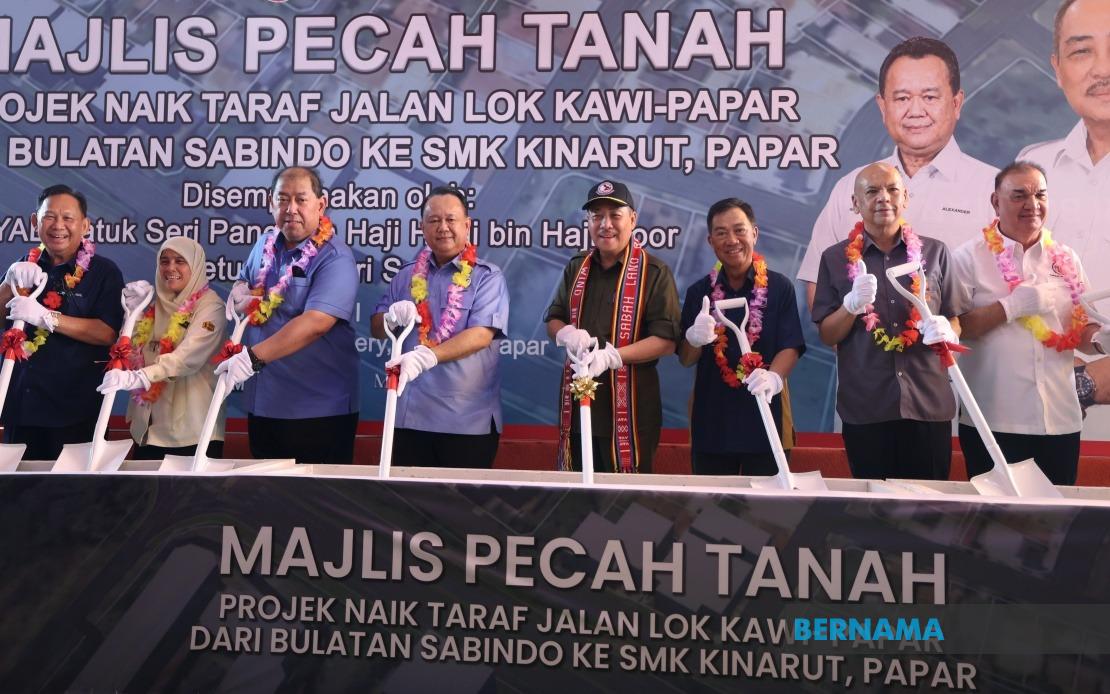
Sabah is proceeding with a RM70.6 million infrastructure initiative to transform Jalan Lok Kawi, with the project spanning 1.3 kilometres from the Sabindo Roundabout to Sekolah Menengah Kebangsaan Kinarut. Chief Minister Datuk Seri Hajiji Noor inaugurated the groundbreaking ceremony in Papar on July 28, underscoring the undertaking as part of the federal government's broader commitment to enhancing transport networks across the state through the Ministry of Works.
The timing of this investment reflects mounting pressures along a critical growth corridor. The Lok Kawi-Pengalat-Papar area has undergone substantial transformation in recent years, with developers launching multiple residential schemes, government buildings expanding their footprint, and educational and tourist facilities being established. This concentration of new development has created a perfect storm of traffic challenges, particularly during morning and evening rush periods when residents, students, and workers converge on the same routes. Commuters and business operators have grown increasingly vocal about delays and safety risks, making infrastructure enhancement an urgent political and practical necessity.
The upgrade itself represents a fundamental restructuring rather than a superficial improvement. The existing two-lane configuration will be widened into a four-lane dual carriageway, doubling capacity and allowing for more fluid traffic flow. However, Hajiji emphasised that the project transcends simple road widening, with planners integrating comprehensive safety and accessibility features throughout the design. These additions signal recognition that modern road infrastructure must serve diverse user groups, not merely accommodate high-speed vehicle movement.
Accessibility and pedestrian safety emerge as defining characteristics of the scheme. The project will incorporate a pedestrian overhead bridge to eliminate conflicts between walkers and vehicles, a covered walkway specifically serving Sekolah Menengah Kebangsaan Kinarut students, and designated bus stops with proper shelters. Motorcycle parking facilities will also be constructed, acknowledging the prevalence of two-wheeled transport throughout Sabah and Malaysia more broadly. These amenities transform what might otherwise be a purely vehicular project into one serving schoolchildren, transit-dependent residents, and the broader community.
Implementation success depends critically on swiftly resolving ancillary matters that often derail infrastructure projects across Southeast Asia. Land acquisition represents a potentially protracted challenge, particularly where the corridor passes through residential or commercial zones with multiple stakeholders holding interests. Utility relocation—shifting water mains, electrical cables, telecommunications lines, and sewerage systems out of the construction path—demands intricate coordination among multiple agencies. Hajiji pointedly called on all relevant government departments and utility providers to act decisively, explicitly warning against bureaucratic delays that might stretch timelines. His language suggests frustration with historical patterns where good intentions have been undermined by administrative friction.
The project carries substantial economic implications extending well beyond the immediate corridor. Reduced travel times and improved reliability attract businesses seeking to establish operations, as predictable transport networks lower operational costs and enhance workforce productivity. The upgrade will strengthen connectivity between Papar and surrounding areas, potentially unlocking commercial opportunities in a district positioned at an intersection of multiple development trajectories. Hajiji identified tourism as a particular beneficiary, noting that Papar's location relative to Brunei and Sarawak could establish it as a convenient stopover once the Pan Borneo Highway achieves full operational status.
Parap itself is experiencing a broader metamorphosis that contextualises this single project within a larger vision. Beyond the Jalan Lok Kawi work, state authorities have green-lit the Second Papar Bridge project and initiated emergency stabilisation and protection works along the Kogopon Intake riverbank. These initiatives collectively demonstrate strategic thinking about district-level development, with transport, water security, and flood management receiving coordinated attention. The projects themselves emerged from requests made by Papar Member of Parliament Datuk Armizan Mohd Ali, illustrating how local political advocacy translates into resource allocation.
The investment also exemplifies federal-state cooperation dynamics within Malaysia's governance structure. While the Ministry of Works funds and oversees the upgrade, successful delivery requires the Sabah state government's active participation in land acquisition and utility liaison. Hajiji's explicit commitment to provide full cooperation signals understanding that infrastructure projects transcend administrative boundaries and demand seamless interagency coordination. His emphasis on strengthening federal-state partnerships suggests recognition that siloed decision-making has historically compromised outcomes in similar ventures.
The broader policy environment shapes this project's significance. As Malaysia pursues economic diversification and regional integration, transport infrastructure investments become critical enablers of growth. The Pan Borneo Highway, once complete, will reposition Sabah within broader East Malaysian commerce and tourism networks. Complementary projects like the Jalan Lok Kawi upgrade ensure that benefits permeate beyond major corridors into secondary districts and community spaces. Without such supporting infrastructure, major thoroughfares risk creating bottlenecks at connection points rather than facilitating seamless movement.
Scheduling pressures will test implementation capacity. Malaysian infrastructure projects frequently encounter delays stemming from weather, unforeseen site conditions, procurement challenges, and the administrative friction Hajiji specifically cautioned against. The project timeline remains unspecified in the groundbreaking announcement, but completion will likely require two to three years depending on scope complexity and real-world obstacles. Contractors will need to balance construction pace against minimising disruption to existing traffic and business operations along this busy corridor.
For Malaysian motorists and Southeast Asian observers monitoring transport development across the region, this initiative offers lessons about how districts outside major metropolitan areas vie for infrastructure investment. Papar's combination of rapid organic growth, strategic geographic positioning, and effective local political advocacy has successfully positioned it for significant state and federal resource commitments. Similar dynamics play out across Malaysia and the wider region, where secondary cities increasingly compete for development resources and investment.
The project ultimately represents a bet on Papar's continued relevance within Sabah's economic geography. By investing in transport capacity, safety, and accessibility today, authorities signal confidence that demand justifying these improvements will materialise as planned. Should development proceed as expected, the RM70.6 million outlay will prove justified by economic activity, reduced congestion, and improved quality of life. Conversely, if anticipated growth fails to materialise, the infrastructure may temporarily exceed immediate needs. Such calculation and risk underpin all development spending, making careful monitoring of project outcomes valuable not merely for Papar but for broader understanding of how Malaysian infrastructure investments perform relative to projections.

