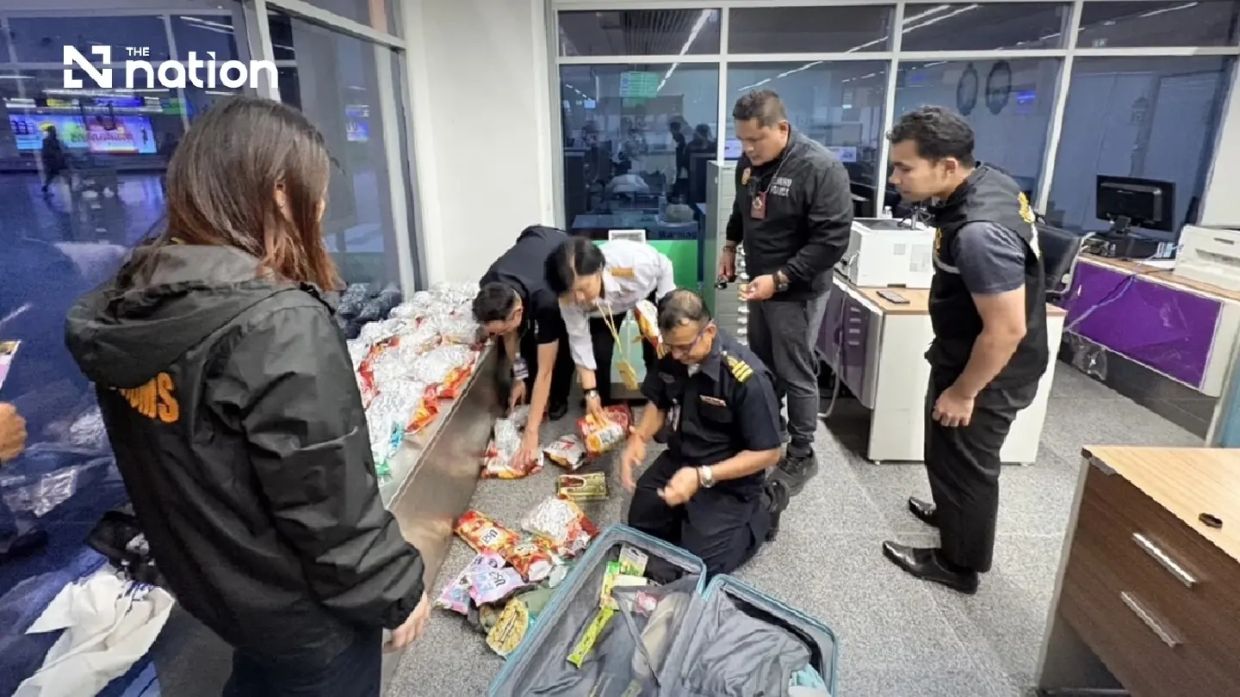
A 30-year-old Russian national faces smuggling charges after customs officials at Phuket International Airport uncovered more than 17 kilograms of cannabis in his luggage as he prepared to depart Thailand on Wednesday. The discovery, made during a routine inspection at the international departure terminal, represents a significant interdiction of narcotics trafficking through one of Thailand's busiest transport hubs and underscores the country's ongoing efforts to combat drug smuggling through its airports.
The incident occurred in the Mai Khao subdistrict of Thalang district when customs officer Rawin Kanokakorn and an arresting team conducted a standard examination of two blue BP WORLD wheeled suitcases belonging to Sergei Chalabari. The combined weight of the luggage initially registered at eight kilogrammes, but the contents told a different story once officers began their detailed inspection of the bags.
Inside the suitcases, authorities discovered 35 vacuum-sealed packages containing cannabis flowers with a combined gross weight of 11.4 kilogrammes, alongside 12 additional packages of cannabis resin weighing 6.2 kilogrammes in total. The substantial quantity suggests this was not a personal use quantity but rather a deliberate smuggling operation, with the vacuum-sealing method indicating a sophisticated attempt to evade detection. Both the narcotics and the suitcases themselves were immediately seized as evidence.
During preliminary questioning at the airport, Chalabari acknowledged that both the suitcases and all seized items belonged to him, effectively admitting to possession of the contraband. This admission significantly strengthened the legal case against him and expedited the formal charging process. Thai authorities subsequently informed him that he was being charged with attempting to smuggle goods out of the kingdom without complying with customs declaration requirements, a serious offense under Thai law that carries substantial penalties.
The swift response and professional coordination demonstrated in this case reflects Thailand's commitment to maintaining strict border security, particularly at international airports where trafficking networks frequently attempt to move drugs and other illicit goods. The operation was overseen by Pol Col Salan Sankhisasanakun, superintendent of Sakhu Police Station, and Pol Lt Col Rattanawut Nukaew, deputy superintendent for investigation. Their involvement at senior levels underscores the gravity with which Thai authorities treat such incidents.
The customs side of the operation was led by a coordination team including Nucha Jeeradit, chief of the Phuket Airport Customs House; Thanomjit Burirak, director of the customs control division; and Charoenporn Jaengwansuk, chief of the investigation and suppression section. This multi-agency approach, combining customs expertise with police investigative capacity, has become standard practice in Thailand's efforts to intercept drug trafficking at ports of entry.
Following the airport detention, Chalabari was transferred to Sakhu Police Station where Pol Capt Chaphinya Surithamkul, deputy investigation inspector, received him for further legal proceedings. The transfer of custody from airport authorities to local police ensures that a comprehensive investigation can proceed and that the suspect faces the full weight of Thailand's drug laws. The case will likely involve coordination with Russian consular authorities given the suspect's nationality.
This seizure comes amid broader Thai enforcement campaigns targeting narcotics trafficking through the country's transportation infrastructure. Phuket, as a major tourist and transit destination, represents a high-priority interdiction point for customs and police agencies. The airport serves hundreds of thousands of international passengers monthly, making vigilant screening operations essential for detecting contraband before it leaves Thai jurisdiction.
For regional observers, the case illustrates how Southeast Asian airports have become focal points in global drug smuggling routes. Criminal networks attempt to exploit the heavy passenger volumes and logistical complexity of international aviation hubs to move contraband between continents. Thailand's relatively strict penalties for drug trafficking serve as a deterrent, yet the persistence of such smuggling attempts demonstrates the substantial profit margins that motivate traffickers to take risks.
The consequences for Chalabari could be severe under Thai law. Drug smuggling charges, particularly involving quantities exceeding 17 kilograms, typically result in lengthy prison sentences and substantial fines. The fact that he admitted ownership during questioning means he cannot easily dispute possession, and Thai courts generally treat such admissions as damaging to a defendant's legal position.
This case also highlights the important role that routine customs screening plays in drug interdiction. Rather than representing an anomalous incident, such discoveries are part of a steady stream of contraband interceptions that occur daily at major international airports throughout Southeast Asia. Each successful interdiction represents drugs that will not reach markets and criminal proceeds that will not fund trafficking organizations.

