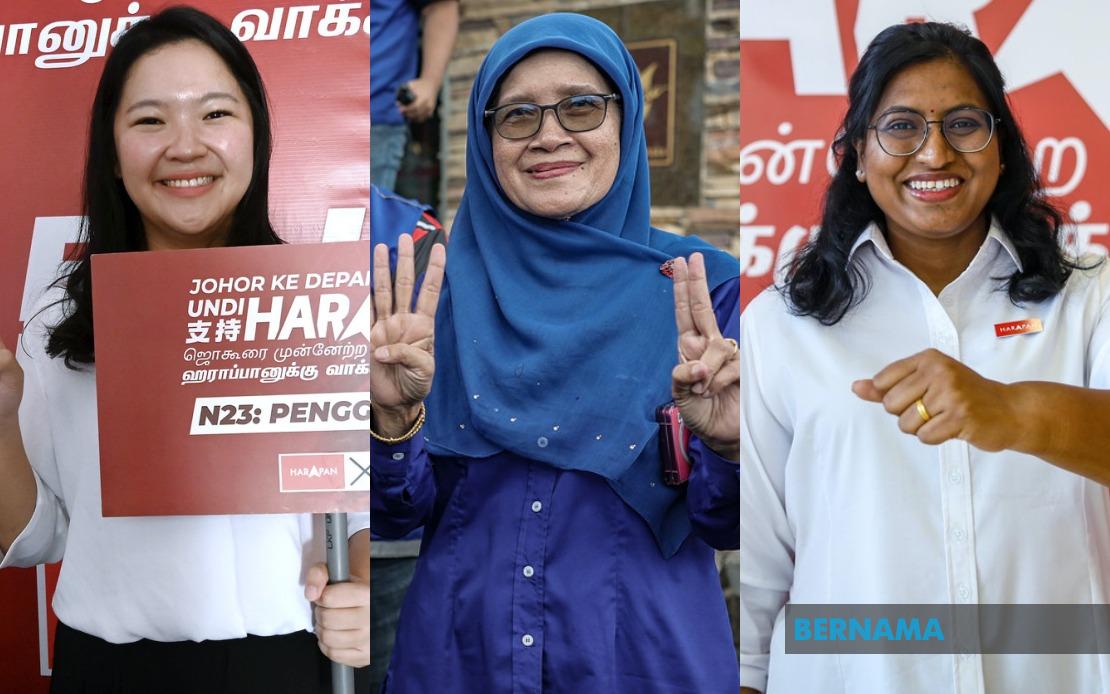
The 16th Johor State Election has concluded with ten women among its winners, a result that reflects the state's continuing openness to female representation in its Legislative Assembly. The successful candidates comprised seven from Barisan Nasional and three from Pakatan Harapan, a distribution broadly reflecting the overall election outcome which saw BN secure 48 of the 56 available seats. Though the figure demonstrates ongoing acceptance of women in political leadership roles, the achievement must be contextualised against the total field: these ten victors emerged from just thirty-four female candidates, accounting for nearly one-fifth of all aspirants contesting the state polls.
Barisan Nasional's female contingent proved particularly successful in consolidating support across Johor's diverse constituencies. Nadhirah Afiqah Abdull Rahim, making her electoral debut as Ledang Puteri UMNO chief, captured the Serom seat with a comfortable margin of 9,406 votes, prevailing over both a Perikatan Nasional challenger and a Pakatan Harapan contender. In Parit Raja, Nor Rashidah Ramli strengthened BN's dominance by securing 19,572 votes and a substantially enlarged majority of 13,576 votes—nearly treble the 4,219-vote margin achieved in the previous 2022 state election—signalling a notable shift in voter sentiment toward the coalition in that constituency. Alwiyah Talib demonstrated remarkable electoral longevity by capturing the Endau seat for the third consecutive term, winning by 3,041 votes despite fielding a four-way contest that included candidates from Perikatan Nasional, the Malaysian Orang Asli Party, and Pakatan Harapan.
Other BN women candidates delivered commanding victories that underscore the coalition's resilience in the state. In Johor Lama, incumbent assemblyman Norlizah Noh secured a substantial majority of 16,344 votes in a three-cornered contest, notably defeating the election's youngest candidate, Danish Hossman Abd Rahman of Pakatan Harapan. Fauziah Misri produced a landslide result in Penawar with 15,776 votes, while Hasrunizah Hassan successfully retained the Pulai Sebatang seat she previously held, improving her winning margin by 6,325 votes compared to 2022. Perhaps most significantly, Chan San San orchestrated an upset in Johor Jaya, a constituency long regarded as a Democratic Action Party stronghold, accumulating 35,971 votes to defeat representatives from Pakatan Harapan, independent candidates, and Parti Bersama Malaysia.
Pakatan Harapan's female representatives navigated a more challenging political environment but managed to retain crucial constituencies. Felicia Poh Rui Ling, aged just twenty-eight, recorded her maiden victory in Penggaram by defeating the Barisan Nasional incumbent with a 4,137-vote majority in a direct contest. Her election carries particular significance as a younger generation female candidate consolidating an opposition-held seat. Chu Poh Yee maintained Pakatan Harapan's control of Mengkibol with a 4,213-vote majority against the Barisan Nasional challenger, while Kartiyaini Jeyapalan, a Skudai-born lawyer, retained the traditionally opposition-aligned Skudai seat with a commanding 15,280-vote margin despite facing a four-way competition involving candidates from Barisan Nasional, Parti Bersama Malaysia, and Parti Sosialis Malaysia.
The overall representation of women in the Johor election merits analysis within Malaysia's broader context of female political participation. Thirty-four female candidates represented approximately one-fifth of the 172-candidate field, a proportion that highlights both incremental progress and persistent underrepresentation compared to male aspirants. In the decades following the formation of Malaysia as a nation-state, women's participation in electoral politics has evolved considerably, yet gender parity in candidacy remains elusive across most Malaysian states. Johor's performance reflects patterns observable nationwide, where women encounter systemic barriers to candidacy through party gatekeeping, candidate selection processes that privilege male contenders, and ingrained assumptions about electability.
Geographic and demographic variations shaped the electoral pathways for female candidates across Johor's diverse constituencies. Urban-centred seats such as Johor Jaya and Skudai, characterised by higher educational attainment and more heterogeneous electorates, witnessed competitive performances from female candidates representing both major coalitions. Conversely, rural and semi-rural constituencies demonstrated variable patterns of female candidate success, with some delivering impressive margins while others faced steeper challenges. These variations suggest that localised factors—incumbent strength, party organisation, community demographics, and candidate profiles—interact with gender considerations in shaping electoral outcomes.
The composition of Johor's newly elected female assemblymen merits examination for socioeconomic and professional backgrounds. Kartiyaini Jeyapalan's identification as a legal professional, alongside candidates holding leadership positions within party structures like Nadhirah Afiqah's role as Ledang Puteri UMNO chief, indicates that female candidates who ascend to electoral success often possess professional credentials and organisational experience. This pattern raises questions about barriers confronting female candidates from broader socioeconomic backgrounds and whether party systems adequately foster leadership development among women outside professional and elite circles. The inclusion of Felicia Poh as a notably younger victor may signal evolving party strategies toward generational renewal.
Barisan Nasional's seven female victors and the coalition's commanding fifty-six-seat supermajority in the state assembly carry implications for legislative agenda-setting and policy implementation during the forthcoming term. With the overwhelming majority of seats, BN holds substantial latitude in determining priorities without requiring cross-coalition consensus. Female BN assemblymen, while comprising a minority within the coalition's legislative contingent, may exercise influence in specific policy domains such as social welfare, education, and family-related legislative initiatives, areas where women legislators have traditionally advocated distinctive priorities in Malaysian state assemblies.
Packatan Harapan's three female victors assume roles within an opposition that holds only eight seats in a fifty-six-seat chamber, substantially limiting legislative leverage but maintaining crucial representative functions. Opposition female assemblymen historically shoulder responsibility for articulating alternative perspectives on governance, scrutinising executive decisions, and maintaining public discourse on contested policy domains. The retention of seats in constituencies such as Skudai and Mengkibol by PH women candidates preserves the coalition's electoral foothold in urban constituencies where younger voters and professionally qualified constituents represent growing demographics.
The election results invite reflection on voter preferences regarding female political leadership across Johor's socially diverse constituency base. Substantial majorities achieved by candidates such as Norlizah Noh and Kartiyaini Jeyapalan, alongside the upset victory of Chan San San in a traditionally opposition-held urban seat, indicate that gender does not necessarily constrain electoral viability. Rather, candidate qualities including incumbency, professional credentials, party affiliation, and local rootedness appear to override gender as determining factors in voting behaviour. This pattern offers cautiously optimistic evidence that Malaysian electorates increasingly evaluate female candidates through criteria similar to those applied to male contenders.
Looking forward, the Johor election outcome establishes a baseline for tracking female political advancement in Malaysia's most populous state. The ten female victors represent progress from previous cycles whilst remaining disproportionately small relative to population-wide female representation. Acceleration toward greater female candidacy and electoral success will likely require conscious party initiatives including transparent candidate selection mechanisms, mentorship programmes developing female political talent, targeted campaign resource allocation, and public discourse reframing female political leadership as normative rather than exceptional. Malaysian civil society organisations monitoring democratic development, alongside researchers examining electoral behaviour, will scrutinise whether the modest gains achieved in Johor catalyse momentum toward more substantive female parliamentary representation in future electoral cycles.

